

Summarize this blog post with:
Quick Summary
Explore SMS marketing vs email marketing in 2026 and discover which channel delivers higher engagement, faster responses, better conversions, and stronger ROI for modern businesses and customer communication strategies.
Every marketer today is sitting on the same fence. On one side, email is reliable, rich, and proven. On the other hand, SMS is instant, direct, and impossible to ignore. But in 2026, the real question is not which channel sounds better on paper. It is the one that automates better, converts faster, and delivers measurable results for your specific goals.
The data sets the stage: SMS messages carry a high open rate, email delivers an average ROI of $36–42 for every dollar spent, and consumers who opted into a brand's SMS program also engaged with that brand's emails. Neither channel is irrelevant, and choosing between them without context is the wrong move.
By the end of this blog, you will know exactly how sms marketing vs email marketing stacks up across automation, performance, cost, and compliance, and which combination drives better results in 2026.
What Is SMS Marketing vs Email Marketing, And Why the Comparison Still Matters in 2026
SMS Marketing: It is a permission-based channel in which businesses send text messages directly to customers' mobile numbers. Every message lands on the lock screen, no inbox competition, no algorithm deciding whether it gets seen. Standard SMS texts are capped at 160 characters, though MMS allows images, GIFs, and short videos. Because of its immediacy and near-universal reach, SMS has become one of the most direct lines a brand has to its audience.
Email Marketing: the practice of sending targeted messages to a subscriber list via email inboxes. Unlike SMS, email has no content length restrictions, it supports rich visuals, multiple CTAs, long-form storytelling, video embeds, and complex segmentation logic. It is the backbone of most marketing funnels, used for everything from welcome sequences and product launches to nurture campaigns and win-back flows.
So, Why Does This Comparison Still Matter In 2026?
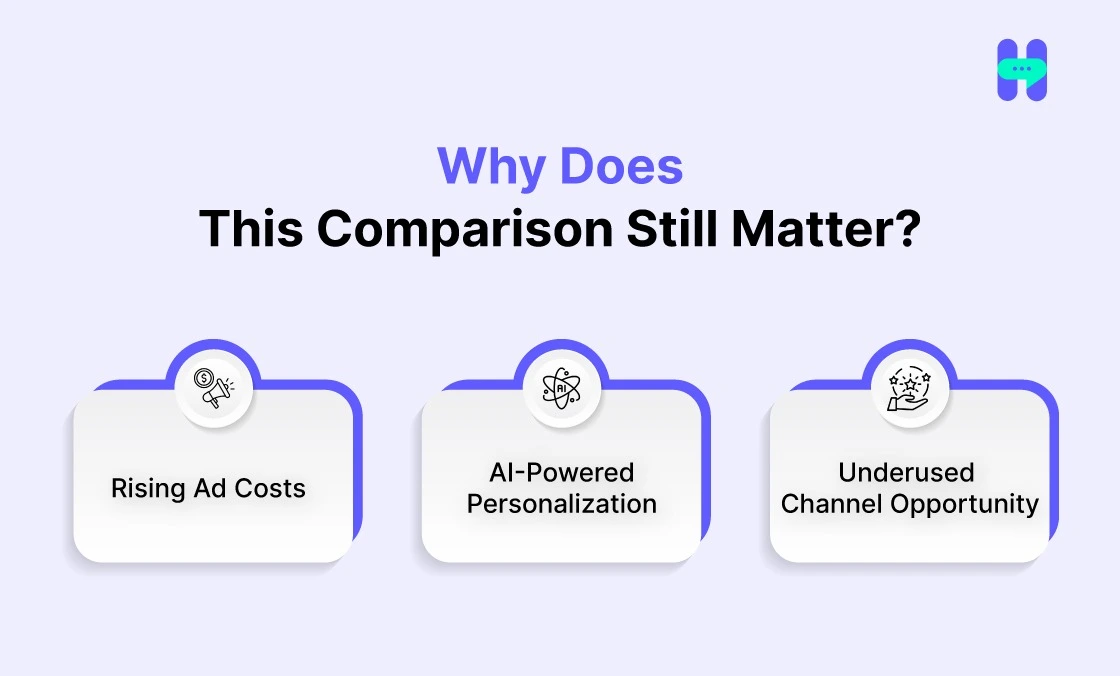
There are three reasons:-
First: Digital ad costs have risen sharply, pushing brands toward owned channels where they control the audience.
Second: Both SMS and email have evolved, and AI-powered personalization is now built into both channels, raising the performance ceiling for automation.
Third: Most businesses are still investing heavily in one channel while underusing the other, leaving real revenue on the table. Understanding the genuine strengths of each is no longer optional; it is a competitive necessity.
Sms Marketing Vs Email Marketing - Head-to-Head Comparison
SMS Automation, How It Works and Where It Wins
SMS automation is the practice of sending text messages in response to customer behavior, time-based rules, or predefined conditions, without manual intervention. Think of it as a behavior-responsive system: a customer abandons a cart, a message fires. A subscriber has not engaged for 60 days, so a re-engagement text is sent. A purchase is confirmed, and a follow-up sequence begins.
The core components of SMS automation include behavior-triggered messages, drip sequences, keyword-based auto-replies, and two-way conversational flows that allow customers to respond and interact in real time.
Top SMS Automation Use Cases in 2026
Abandoned cart recovery texts: A customer adds items to their cart and leaves without purchasing. An automated SMS is sent within 15–30 minutes, including a direct link back to their cart and sometimes a time-limited incentive.
Appointment reminders and confirmations: For service businesses, healthcare providers, and SaaS onboarding teams, automated SMS reminders dramatically reduce no-shows. Because texts are read within minutes, they work better than email for time-sensitive confirmations.
Flash sale and limited-time offer triggers: When urgency is the point, SMS is the channel. A flash sale that expires in 4 hours needs to be seen immediately. Automated SMS campaigns tied to inventory triggers or promotional calendars are one of the highest-converting use cases in ecommerce.
Post-purchase follow-up sequences: After a purchase, an automated SMS sequence can deliver order confirmation, shipping updates, delivery confirmation, and a review request, all without a single manual send. Additionally, using automated texting software will be a great way to reduce workload.
Re-engagement flows for lapsed subscribers: Subscribers who have not opened an email in 90 days are often still reachable via SMS. Automated re-engagement texts with a direct offer or personalized message can recover segments that email alone cannot reach.
Why Hellosend Is the Best SMS Marketing Tool For 2026?
Now that you understand where SMS automation wins, and it wins decisively in high-intent, real-time moments, the tool you use to execute that strategy matters as much as the strategy itself.
A clunky platform with poor compliance support and limited automation logic will cost you conversions, time, and potentially legal risk. That is where Hellosend comes in.
HelloSend: It is an SMS marketing and automation platform built for growing businesses that want to reach their customers at exactly the right moment, without spending weeks setting up a complex system. It is designed for marketing managers, ecommerce operators, and growth teams who need a powerful SMS tool that is fast to launch, easy to manage, and built to scale.
What Makes Hellosend Stand Out in 2026?
HelloSend Pricing
Hellosend offers flexible pricing plans built to fit businesses of every size, whether you are just getting started with SMS marketing or scaling to a large contact list. You only pay for what you need, with no hidden fees or complicated contracts getting in the way. Visit the Hellosend Pricing Page to find the plan that fits your budget and start sending in minutes.

When SMS Wins, 5 Scenarios
SMS is the stronger choice when immediacy is non-negotiable. These are the five situations where it consistently outperforms email:
- Time-Sensitive Promotions: Flash sales, expiring discounts, and limited inventory alerts need to be seen within minutes, not hours.
- Abandoned cart recovery: The speed advantage of SMS means you reach the customer while their intent is still warm.
- Appointment reminders: For any business where no-shows cost money, SMS reminders drive confirmation rates that email cannot match.
- Transactional updates: Order shipped, delivery confirmed, payment received. These messages belong on a lock screen.
- Re-engaging cold email subscribers: When email open rates drop to near zero for a segment, SMS is often the only owned channel that can bring them back.
Conclusion
So, SMS automation vs email marketing: which delivers better results in 2026?
The answer is not one or the other. SMS wins on immediacy, open rates, and real-time conversion moments. Email wins on ROI, content depth, automation sophistication, and cost efficiency at scale. If you are forced to choose one, let your primary goal decide: choose SMS when your biggest problem is getting seen and driving instant action; choose email when your biggest problem is nurturing, educating, and converting over time.
But if you are ready to play at the level where the best-performing brands operate, the decision is to use both: SMS marketing automation for high-intent moments and email automation for the full customer journey.
In 2026, owned channels are more valuable than ever. Every contact on your SMS list and email list is an asset that no algorithm can take away from you. The businesses that invest in and intelligently automate both will have a durable competitive advantage over those still waiting to decide.
If SMS automation is where you want to start, start with the right tool. Hellosend makes it simple to build, launch, and scale your SMS automation without the technical complexity or compliance risk.
FAQs
Q1. Is SMS marketing more effective than email marketing for time-sensitive promotions?
Yes. SMS delivers messages to the lock screen and is read within an average of 3 minutes, making it significantly more effective than email for flash sales, expiring offers, and any promotion where timing directly affects conversion.
Q2. What is the average ROI of SMS automation compared to email marketing automation?
SMS automation delivers an estimated $8–12 ROI per dollar spent, while email marketing automation delivers $36–42 per dollar spent. Email wins on ROI due to its lower cost per send at scale, but SMS wins on engagement metrics such as open and click-through rates.
Q3. Can small businesses afford to run both SMS and email marketing simultaneously?
Yes, with the right tools. Email platforms are affordable at low list sizes, and SMS costs are manageable when used strategically for high-impact moments rather than high-frequency sends. Starting with email as the primary channel and layering in targeted SMS automation is a practical and cost-effective approach for most small businesses.
Q4. How many SMS messages can I send per month before subscribers start opting out?
Industry benchmarks suggest 4–6 SMS messages per month is the sweet spot for most audiences. Beyond that, opt-out rates tend to rise sharply. Relevance and timing matter as much as frequency, a well-timed, highly relevant SMS at 6 sends per month will outperform a generic message at 2.
Q5. What compliance rules do I need to follow before launching an SMS automation campaign in 2026?
In the US, you must complete 10DLC registration through The Campaign Registry, obtain explicit written consent from every subscriber before sending, include an opt-out option in every message, and respect permitted send hours (8 am–9 pm in the recipient's local time zone). TCPA violations carry fines of $500–$1,500 per unsolicited message, so compliance must be built into your setup before your first send.
.webp)


.webp)
