
Summarize this blog post with:
Quick summary
WhatsApp lead generation fails when replies pile up with no process behind them. This blog lays out the steps that turn a WhatsApp reply into a qualified, booked demo: pick one buying signal, qualify in the chat, score and route by intent, then log the outcome to the CRM. Follow the framework, and WhatsApp becomes a pipeline channel your team can report on, not just a phone that gets replies.
Your WhatsApp number gets replies. Your pipeline does not move. Somewhere between "hey, interested!" and a booked demo, the conversation stalls.
That's not a WhatsApp problem. It's a process problem. Most B2B SaaS teams run WhatsApp lead generation like a broadcast channel when it works best as a qualification engine.
This blog covers the process that turns a WhatsApp reply into a qualified demo booking with the right WhatsApp marketing strategy.
Why does WhatsApp lead generation break down for B2B SaaS teams?
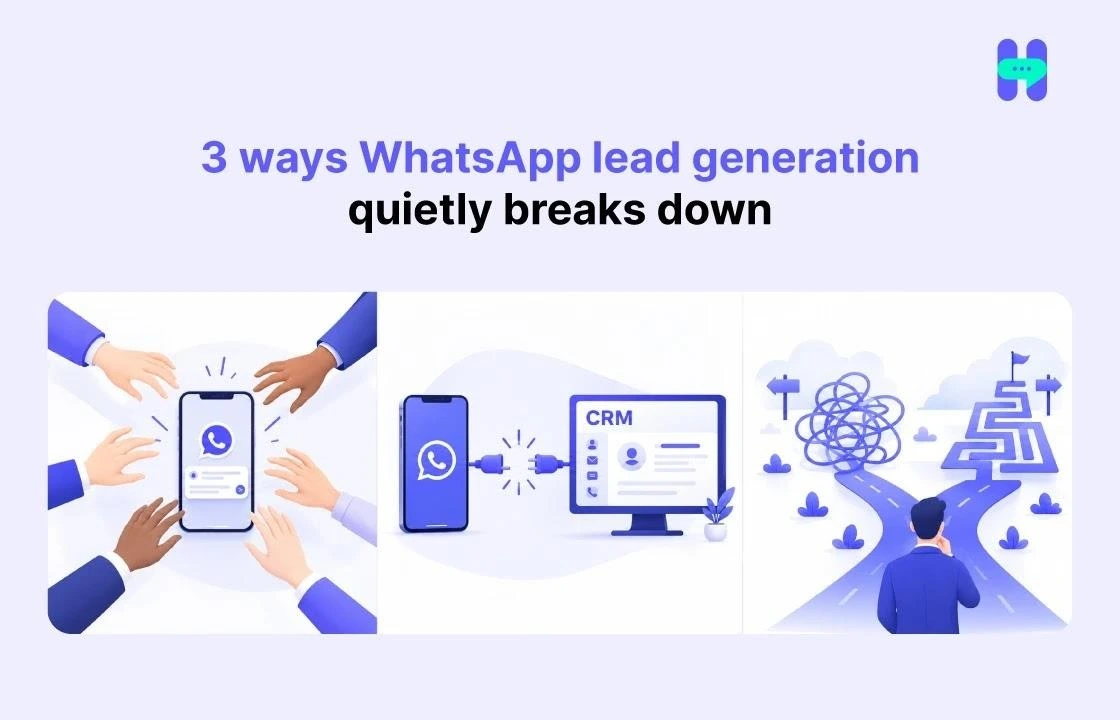
Three patterns show up again and again in teams that struggle with WhatsApp lead generation.
Problem 1: Messages go out, but no one owns the reply
A message goes to a list with no clear reason for the send. A prospect replies, and three different reps handle it three different ways. The prospect feels marketed to, not helped.
What breaks this:
- No trigger tied to a specific buying signal, like a pricing page visit or a form fill
- No agreed script for what happens after the first reply
- No owner assigned before the reply lands
Problem 2: The chat lives on a phone, not in the CRM
WhatsApp conversations sit in an app separate from the deal record. A manager cannot see which chats turned into demos. When a rep leaves the company, the conversation history leaves with them.
What breaks this:
- No connection between the messaging tool and the CRM
- No log of what was said, only a message count
- No way to report on WhatsApp as a channel, only anecdotes
Problem 3: Teams pick between manual chaos and a rigid bot
An all-manual WhatsApp process means slow replies and inconsistent tone across reps. A rigid bot means a frustrating loop of menu options that cannot handle a real question. Neither turns a WhatsApp lead into a booked demo.
What breaks this:
- No clear point where an automated reply hands off to a human
- No shared view, so the next rep starts from zero
- No visibility into where prospects drop out of the WhatsApp conversation
How do you turn a WhatsApp conversation into a qualified demo booking?
This is the part most WhatsApp guides skip. A WhatsApp message is rarely just a message. It is often the first sign that someone is looking for a solution, comparing options, or trying to solve a problem.
But turning that first conversation into a booked demo takes more than sending a product link or asking, “Can we schedule a call?” You need to understand what the prospect needs, guide the conversation naturally, and make the next step easy.
1. Start With Conversations That Matter
A strong sales conversation begins with the right audience. If you are reaching people who have no interest or immediate need, even the best sales process will struggle.
Segment your audience based on factors such as their industry, previous interactions, product interest, location, or buying stage. This helps you start conversations with people who are more likely to find value in your solution.
2. Guide Prospects Through a Simple Journey
A good WhatsApp conversation should feel natural, not like a sales script. The goal is to help prospects move from curiosity to confidence.
A simple flow looks like this:
- Understand their reason for reaching out
Find out what they are looking for and why they started the conversation. - Ask the right questions
Learn about their challenges, goals, timeline, and requirements. - Connect their needs to your solution
Show how your product can help instead of pushing features. - Invite them for a demo
When there is a clear fit, make the next step simple. - Follow up with value
If they are not ready, continue the conversation with useful insights instead of repeated sales messages.
3. Use Automation Without Losing the Human Touch
Quick responses can make or break a sales opportunity. Customers expect fast answers, especially when they are actively exploring a solution.
Automation can help you handle common questions, collect basic details, and keep conversations moving. But automation alone cannot build trust.
The best approach is simple: let automation handle repetitive tasks and let your team step in when prospects need guidance, answers, or a more personal conversation.
4. Ask Questions That Reveal Real Intent
Not every person who messages you is ready for a demo. The right questions help you understand whether they are a good fit without making the conversation feel like an interview.
Try questions like:
- “What are you hoping to improve with a new solution?”
- “What challenges are you facing right now?”
- “Are you looking to solve this soon or still exploring options?”
- “What would make this solution successful for your team?”
These answers help your sales team focus on genuine opportunities and personalize the demo experience.
5. Remove Friction From Demo Booking
Once a prospect shows interest, do not make them work hard to take the next step.
Share available time slots, connect them with the right person, or provide a simple booking option. The easier it is to schedule a demo, the less likely you are to lose a high-intent lead.
6. Turn Every Conversation Into a Learning Opportunity
As WhatsApp conversations grow, managing them manually becomes difficult. A CRM integration helps teams keep track of conversations, assign leads, remember previous interactions, and follow up at the right time.
Track important metrics like:
- First response time
- Qualified lead rate
- Demo booking rate
- Follow-up engagement
- Conversion rate
The goal is not just to start more conversations. It is to create better conversations that lead to real business opportunities.
What should you look for in a WhatsApp lead generation platform?
Once the process above makes sense, the question becomes which platform supports it, instead of getting in the way.
- Triggers that match your funnel. Can you start a conversation from a specific action, like a pricing page visit or a stalled trial, instead of a static list?
- Two-way conversation design. Does the platform expect and handle replies, or is it built for one-way sends?
- CRM visibility. Is every chat saved on the contact or deal record, and can a manager pull a report on demos booked from WhatsApp without exporting a spreadsheet?
- A clear human handoff. Can a rep step into a conversation mid-flow and see the full history, not only the last message?
- Compliance built in. Does the platform manage WhatsApp template approval and the 24-hour messaging window, or does that fall on your team?
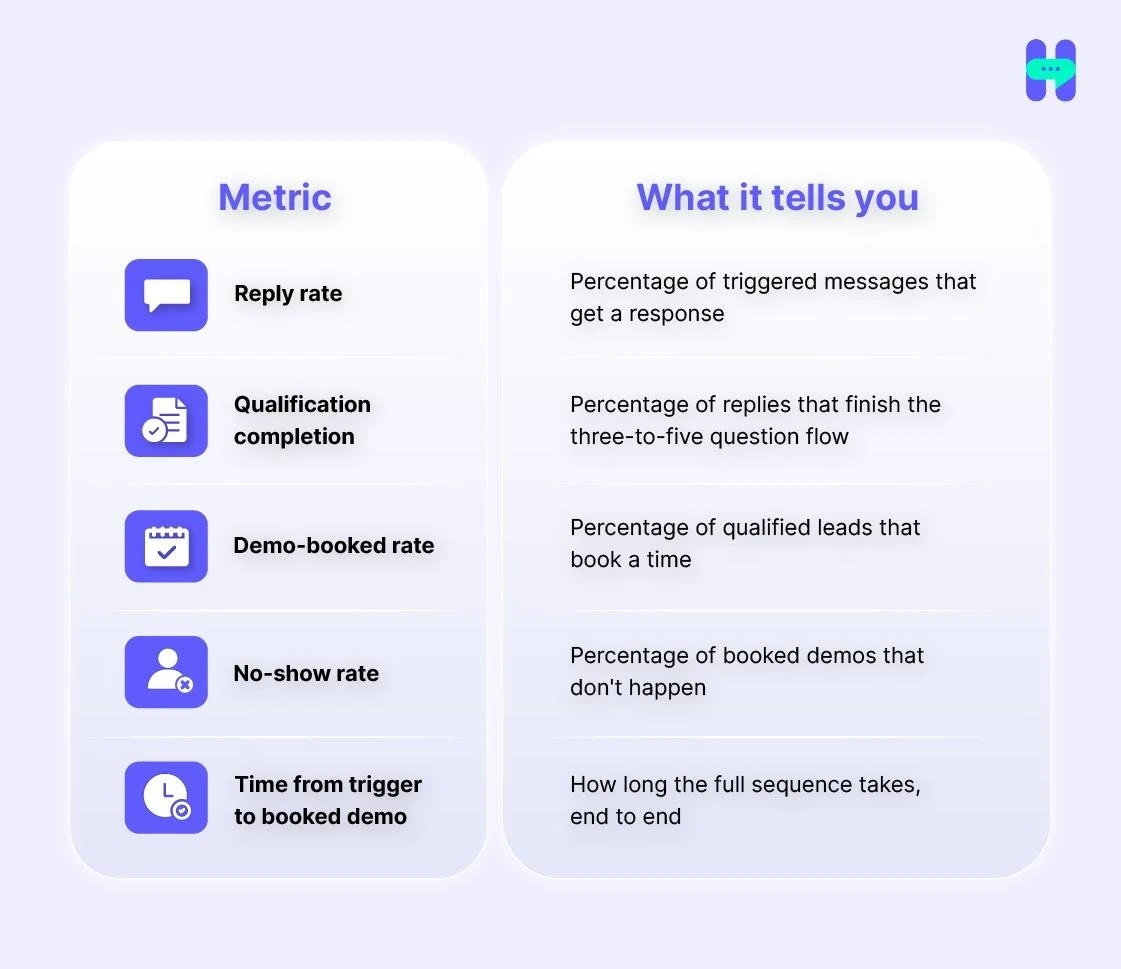
What should you track once it's live?
Set a baseline in the first month, then compare month over month rather than chasing an industry number that may not fit a B2B SaaS sales cycle.
How does HelloSend support Whatsapp lead Generation Process?
.webp)
HelloSend connects WhatsApp, SMS, and voice to the CRM your team already runs on: Zoho, HubSpot, Pipedrive, Zendesk, and Microsoft Teams through native marketplace apps, and Salesforce through a connector that supports workflow-rule-based automation.
- Segment from live CRM fields. Build the outreach list from deal stage or lead source, with no export step between the CRM and the WhatsApp message.
- One unified conversation view. See every chat in one place, filterable by channel, status, or assigned rep, instead of checking a phone screen no one else can access.
- One-click handoff with full history. Assigning a chat sends an email notification to the rep, and the complete conversation travels with it, so the next person doesn't start from zero.
- AI-assisted replies. A rep answers common qualifying questions without typing the same response from scratch every time.
- Message logs that export to CSV. Demo-booked numbers feed straight into whatever reporting the team already runs, instead of staying trapped in a chat app.
CRM integrations that keep the deal record whole
HelloSend connects to Zoho, HubSpot, Pipedrive, Zendesk, and Microsoft Teams through native marketplace apps, and to Salesforce through a connector that supports workflow-rule-based automation.
See HelloSend integrations.
Pricing
HelloSend's Standard plan costs $75 a month for three users, or $60 a month billed annually. It includes a 10,000-message pool, and additional users cost $25 a month each.
For a three-person team qualifying WhatsApp leads, that works out to $25 per rep per month, with room to add a fourth or fifth rep at the same rate instead of jumping to a new plan.
Conclusion
A working WhatsApp demo booking process doesn't run on more messages. It runs on one trigger, one qualification path, and one deal record that shows whether the conversation turned into revenue.
Teams that get this right stop treating WhatsApp as a messaging app and start treating it as a pipeline stage, with the same ownership and reporting as email or calls.
The gap between a WhatsApp number that gets replies and a WhatsApp channel that books demos is not effort. It's whether the platform underneath makes qualification, routing, and CRM logging a default, not a manual habit each rep has to remember on top of everything else.
Ready to turn WhatsApp replies into booked demos?
FAQ
1. How can WhatsApp be used for lead generation?
WhatsApp lead generation works when a message starts from a specific buying signal, not a static contact list. A pricing page visit, a stalled trial, or a webinar signup can each trigger an opening line that qualifies the lead in 3 to 5 questions, then routes it to a rep by intent level.
2. What are the best WhatsApp lead generation strategies?
The best WhatsApp lead generation strategies treat the channel as a qualification engine, not a broadcast list.
- Trigger the first message from a buying signal, like a pricing page visit or a stalled trial signup.
- Qualify in the chat with three to five questions instead of a form.
- Score each reply on fit and urgency, then route it to a rep or a nurture sequence.
- Log the outcome to the CRM deal record, not just the chat thread.
3. Can WhatsApp automation help with lead generation?
Automation helps with reminders, template messages sent outside the 24-hour reply window, and AI-assisted replies to common questions. It does not replace the judgment calls in qualification and routing, where a rigid bot turns into a frustrating menu loop instead of a real conversation. The strongest setup pairs automation for repeat steps with a rep who owns the qualifying conversation.
4. How can I convert WhatsApp conversations into qualified leads?
Converting a WhatsApp conversation into a qualified lead is the real test of how to generate leads on WhatsApp: know intent and fit before you decide who gets a rep. Score fit signals like CRM platform and team size, then intent signals like timeline urgency, on every answered question. A prospect on a matching CRM with an urgent timeline gets a rep in minutes; everyone else moves into nurture.
5. Is WhatsApp good for B2B lead generation?
WhatsApp works for B2B lead generation when it replaces a slow email thread with a faster channel tied to a real deal record. It does not work as a cold broadcast tool, since B2B buyers expect a specific reason for the message and a real person on the other end. Teams that connect WhatsApp to the CRM and track demo bookings, not message counts, see it perform as a pipeline channel.