Summarize this blog post with:
Quick Summary
SMS blast pricing depends on your software subscription, message volume, destination country, and carrier charges. Before choosing a provider, compare the complete cost, including message segments, registration, additional users, and overage fees. HelloSend offers a $75/month plan with 10,000 included messages, while carrier charges are billed separately.
You see an SMS blast software plan advertised at $75/month. It looks affordable until you discover that messaging charges, sender registration, and additional user fees increase the actual bill.
This is why SMS blast pricing needs a closer look before you commit to a provider. The total cost depends on how many messages you send, where your recipients are located, how long your messages are, and how the provider bills for delivery.
Most providers charge for three things: the software subscription, message delivery, and applicable registration or setup fees. Some bundle these costs, while others bill them separately.
This guide compares common SMS pricing models, explains the additional costs to check and shows you how to calculate your monthly SMS budget.
What Is SMS Blast Pricing, and What Does It Include?
SMS blast pricing is the total amount a business pays to send bulk text messages through an SMS campaign platform. An SMS blast sends the same or a personalised message to a large recipient list, usually for promotions, announcements, reminders or updates.
Unlike individual SMS, bulk campaigns require tools to manage recipient lists, schedule sends and track delivery. Automated SMS, on the other hand, are triggered by specific customer actions or events.
Most SMS providers charge for three components:
- Software: Access to the campaign platform, contact management, scheduling and reporting.
- Messaging: Charges for delivering SMS through mobile networks.
- Registration and setup: Fees for activating sender numbers, registering business identities or meeting local messaging requirements.
Providers may combine these costs into one subscription or list them separately. Check the billing structure before comparing advertised prices.
How Much Does an SMS Blast Cost?
There is no universal SMS blast price. Some providers charge a monthly subscription, while others bill per message or require you to purchase credits.
Your actual cost depends on the software plan, message volume, recipient location, carrier rates, and any applicable registration fees.
Here is what you should include when calculating the cost:
The messaging component can change significantly based on:
- Destination country: International SMS rates vary by country and carrier.
- Carrier: Different mobile networks may apply different delivery charges.
- Message type: SMS and MMS have different pricing structures.
- Message volume: Some providers offer lower rates for higher sending volumes.
- Billing model: A bundled plan may include delivery credits, while a separate-billing plan charges carrier costs on top of the subscription.
What Factors Affect the Cost of Sending an SMS Blast?
Six factors determine how much you pay for an SMS campaign.
1. Message volume
The more recipients you contact, the more message segments you use. Some providers offer volume discounts, while others charge a fixed rate for every segment.
For example, sending one campaign to 5,000 contacts generally costs less than sending five separate campaigns to the same 5,000 contacts, only if the provider's pricing or campaign structure creates a saving. The number of billable segments remains important.
2. Destination country
SMS delivery rates differ across countries and mobile networks. Sending 10,000 messages to US numbers may cost differently from sending the same volume to recipients in India, the UK or Australia.
If your business runs international campaigns, check destination-specific rates instead of relying on one advertised per-message price.
3. Message length
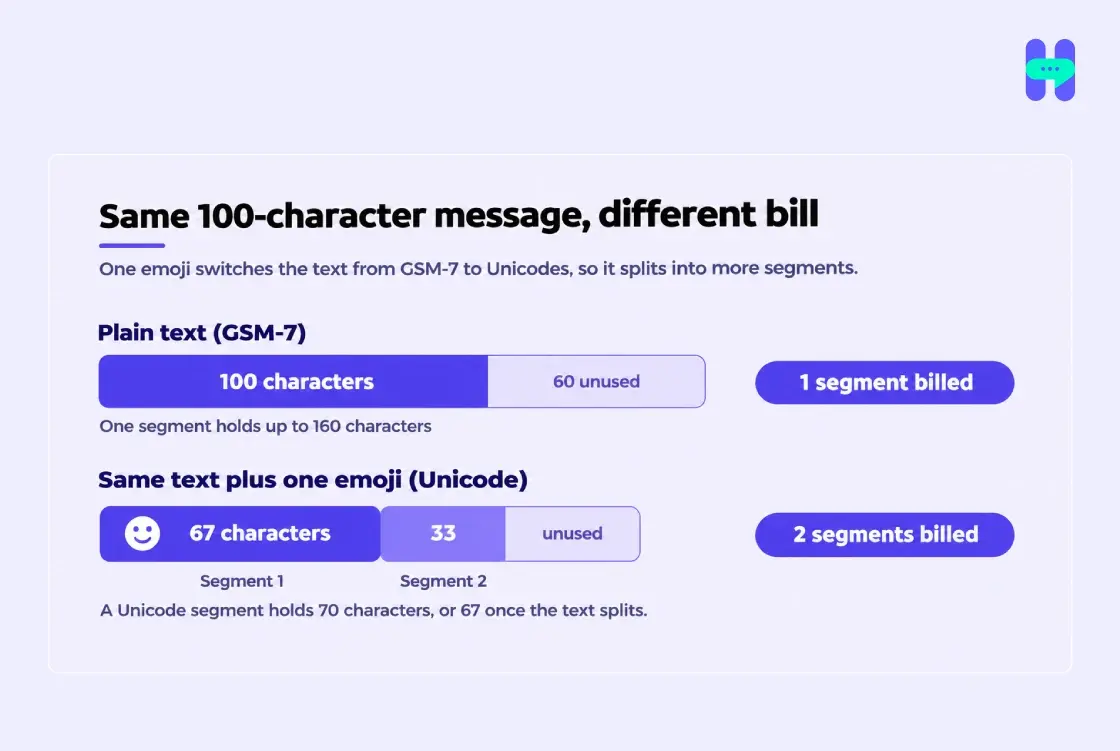
SMS providers may bill long messages as multiple segments rather than one message.
For standard GSM-7 encoding:
- Up to 160 characters: 1 segment.
- Up to 306 characters: 2 segments.
- Up to 459 characters: 3 segments.
For Unicode messages:
- Up to 70 characters: 1 segment.
- Up to 134 characters: 2 segments.
- Up to 201 characters: 3 segments.
Concatenated messages have lower character limits per segment because part of the message capacity is used to reassemble the text on the recipient's phone.
4. Character encoding
Your message's character set also affects billing.
Characters such as emojis, some accented letters, and smart punctuation can switch a message from GSM-7 to Unicode encoding.
A 100-character message that uses GSM-7 may cost one segment. The same message containing a Unicode character may require two segments.
5. Message type
SMS and MMS have different delivery requirements and pricing.
- SMS: Text-based messages used for promotions, reminders, and updates.
- MMS: Messages that support media such as images and other rich content, where available.
If your campaign includes images or other media, check whether the provider supports MMS in your target countries and what it charges.
6. Delivery failures and retries
Failed messages do not always follow the same billing rules.
Some providers charge when a message is submitted, while others have billing rules based on delivery status or carrier acceptance. Retrying a failed message may also create another billable attempt.
Before purchasing, ask:
- Are failed messages charged?
- Are invalid numbers deducted from your allowance?
- Do manual retries create additional charges?
- Are duplicate messages billed separately?
These details help you estimate the actual cost instead of relying only on the campaign's recipient count.
What Are the Different SMS Blast Pricing Models?
SMS blast providers generally use four pricing models. The right option depends on how frequently you run campaigns and how predictable your monthly sending volume is.
Bundled vs. separate carrier billing
The billing structure also affects your total cost.
- Bundled billing: The provider includes messaging charges or a defined message allowance in the subscription. Check whether all destinations and message types are covered.
- Separate billing: You pay the software subscription and messaging provider or carrier charges independently.
Separate billing gives you visibility into delivery costs, but you need to account for both invoices when planning your budget.
What Hidden Costs Should You Check Before Buying SMS Blast Software?
A low monthly subscription does not always mean a low total cost. Check these charges before choosing an SMS blast provider.
Buying tip: Ask the provider for a sample invoice based on your expected monthly volume. This makes it easier to identify charges that are missing from the advertised subscription price.
What Features Should SMS Blast Software Include in Its Pricing?
The software subscription should cover more than the ability to send bulk messages. Check whether it includes the campaign management and CRM features your team needs.
Here is what to look for when evaluating SMS blast software:
HelloSend supports CRM-based recipient selection, CSV imports, message personalisation through merge fields, campaign scheduling and real-time delivery reporting. Teams can also retry failed messages with one click.
Explore HelloSend’s Bulk SMS Campaign feature to see how it works.
How Do You Calculate Your Monthly SMS Blast Budget?
Use this formula to estimate your monthly SMS expenditure:
Your messaging cost is calculated using the total number of billable segments multiplied by the applicable delivery rate.
Follow these three steps.
Step 1: Calculate your monthly message volume
Multiply the number of recipients by the number of campaigns you plan to send.
For example:
- Recipients per campaign: 5,000
- Campaigns per month: 2
- Total messages: 10,000
Step 2: Calculate your billable segments and delivery charges
Assume each message uses one segment and the illustrative delivery rate is $0.01 per segment.
10,000 × $0.01 = $100.
If some messages require multiple segments, increase the billable volume accordingly.
Step 3: Add your software and setup costs
Assume your software subscription costs $75/month and a one-time registration fee is $100.
How Much Does HelloSend Cost for SMS Blasts?
HelloSend offers a fixed software subscription with an included monthly message allowance. Carrier charges are billed separately, so you can see the platform cost and delivery expenses independently.
Here is the pricing breakdown:
What does the subscription include?
The HelloSend subscription covers access to its communication platform and the included message allowance.
You also get:
- Bulk SMS campaign management.
- CRM integrations and automated messaging.
- Contact selection and message personalisation.
- Campaign scheduling and delivery reports.
- Opt-in and opt-out management.
- A shared message allowance across users.
The message allowance increases with team size. The published pricing page lists 10,000 messages for 3 users, 16,000 for 5 users and 31,000 for 10 users. Teams with 15 or more users can request custom pricing.
What is billed separately?
HelloSend does not include carrier charges in its software subscription. Messaging fees from providers such as Twilio and RingCentral are billed separately, without additional HelloSend markup.
For US A2P messaging, the published 10DLC registration fee is $100 as a one-time setup charge.
This structure works for businesses that want a predictable software subscription while keeping delivery costs visible.
Who Should Consider HelloSend?
HelloSend is worth considering if your business:
- Has a team of 3–15 users managing customer communications.
- Uses Zoho CRM or Pipedrive and wants to send campaigns from its CRM workflow.
- Sends regular bulk SMS campaigns to customers or prospects.
- Needs contact selection, message personalisation and delivery reports.
- Prefers a fixed software subscription with separate carrier billing.
Who May Prefer Another Option?
HelloSend may not be the right choice if your business:
- Requires software and carrier charges bundled into one invoice.
- Needs enterprise procurement arrangements or custom contractual terms.
- Prefers a single per-message price that includes all delivery costs.
The key difference is the billing structure. If you want bundled messaging costs, compare providers that include carrier delivery in their advertised rates. If you prefer separate software and delivery charges, HelloSend offers that distinction.
How Do You Compare SMS Blast Services Before Buying?
Compare the total monthly cost rather than choosing a provider based on its advertised subscription or per-message rate.
Ask these six questions before making a decision:
A provider with a lower subscription may become more expensive once you add delivery, registration, and additional user charges. Compare the same sending volume, destinations and message length across providers before deciding.
Conclusion
SMS blast pricing depends on your message volume, destination, software subscription, and additional delivery fees. Compare the complete monthly cost, not just the advertised per-message rate.
HelloSend offers a $75/month plan with 10,000 included messages, three users, and CRM-based campaign management. Carrier charges are billed separately, with no additional HelloSend markup.
If that pricing structure suits your business, try HelloSend before committing to a subscription.
If you are still evaluating campaign tools and strategies, read our guide to SMS blasts.
FAQ
1. How much does an SMS blast cost?
An SMS blast has no single price. The cost is the software subscription, carrier delivery fees and one-time registration. HelloSend’s Standard plan is $75 per month for 3 users and 10,000 messages. Carrier fees and a one-time $100 10DLC setup fee come on top.
2. What fees should I check beyond the per-message rate in SMS blast pricing?
Check six charges. They are sender registration, carrier surcharges, extra user seats, overage fees, MMS rates, and minimum commitments. Ask for a sample invoice at your expected monthly volume. It shows costs the advertised price leaves out.
3. How are long messages and emojis counted in an SMS blast?
A standard text fits 160 characters in one segment, and each segment is billed. Longer texts split into more segments. One emoji or accented letter can switch the text to Unicode, which fits only 70 characters. A 100-character text with one emoji can bill as two segments.
4. Why does my SMS blast bill differ from my recipient count?
Providers bill segments and send attempts, not recipients. A long message uses several segments. Retries, duplicates, and sometimes failed or invalid numbers add charges. Ask your provider which of these it bills before you set a budget.
5. Is bundled or separate carrier billing cheaper for an SMS blast?
Neither is always cheaper. Bundled billing puts delivery on one invoice, which is simpler to track. Separate billing shows delivery cost on its own. HelloSend bills carrier fees separately and adds no markup. Compare the total monthly bill at your own volume.
6. How do I choose the best SMS blast software?
Choose by total monthly cost, not the subscription price. Check that it handles list import, opt-outs, delivery reports, retries, and CRM logging. Ask who bills carrier fees. Compare vendors at the same volume, destinations, and message length.