

Summarize this blog post with:
Quick Summary
Master omnichannel customer communication by unifying SMS, WhatsApp, and Voice in one platform, eliminate channel silos, reduce response times, and deliver seamless customer experiences that drive satisfaction and retention.
Imagine a customer messages your support team on WhatsApp about a delayed order. No response comes fast enough, so they call. The agent who picks up has no idea about the WhatsApp message.
The customer has to explain everything from scratch, again. That frustration is not just a bad experience; it is a symptom of a much bigger problem: fragmented channels with no shared context.
This is exactly where omnichannel customer communication comes in. In this blog, we will break down what it means, why it matters, and how bringing SMS, WhatsApp, and Voice into one platform changes the game for businesses and customers alike.
What is Omnichannel Customer Communication?
Omnichannel customer communication is the practice of connecting all your customer-facing communication channels, SMS, WhatsApp, Voice, email, and more, into a single, unified system where every conversation is continuous, contextual, and consistent. Moreover, utlizing omnichannel marketing will give you best results.
- The core idea is simple: no matter which channel a customer uses to reach you, the conversation never breaks. Their history, preferences, and previous interactions follow them across every touchpoint.
- Think of it this way: a customer receives an SMS alert, follows up on WhatsApp, and escalates to a phone call, all without ever having to repeat themselves. That is omnichannel customer communication working as it should.
Omnichannel vs. Multichannel: What's the Real Difference?
These two terms are often confused, but the difference omnichannel vs multichannel marketing is critical.
Multichannel means your business is present on multiple channels, SMS, WhatsApp, phone, but each one operates in its own silo. There is no shared context between them.
Omnichannel means all those channels are connected. The conversation flows seamlessly from one to the next, and every agent has the full picture regardless of where the customer started.
The table above makes it clear: multichannel is about being present everywhere. Omnichannel is about being connected everywhere.
Why Businesses Are Moving to a Unified Customer Communication Platform
The shift toward a unified customer communication platform is not a trend, it is a response to a very real and measurable business problem.
The Cost of Disconnected Channels
When SMS, WhatsApp, and Voice run on separate tools, the entire support operation pays the price. Agents toggle between tabs and apps. Context is lost every time a customer switches channels.
The same issue gets handled multiple times by different agents who have no visibility into what the previous one already discussed.
What a Unified Platform Changes
When all three channels live inside a single customer communication platform, everything changes for the agent and the customer.
An agent handling a Voice call can see the WhatsApp message the customer sent yesterday and the SMS they received this morning, all in one view, before the customer says a word.
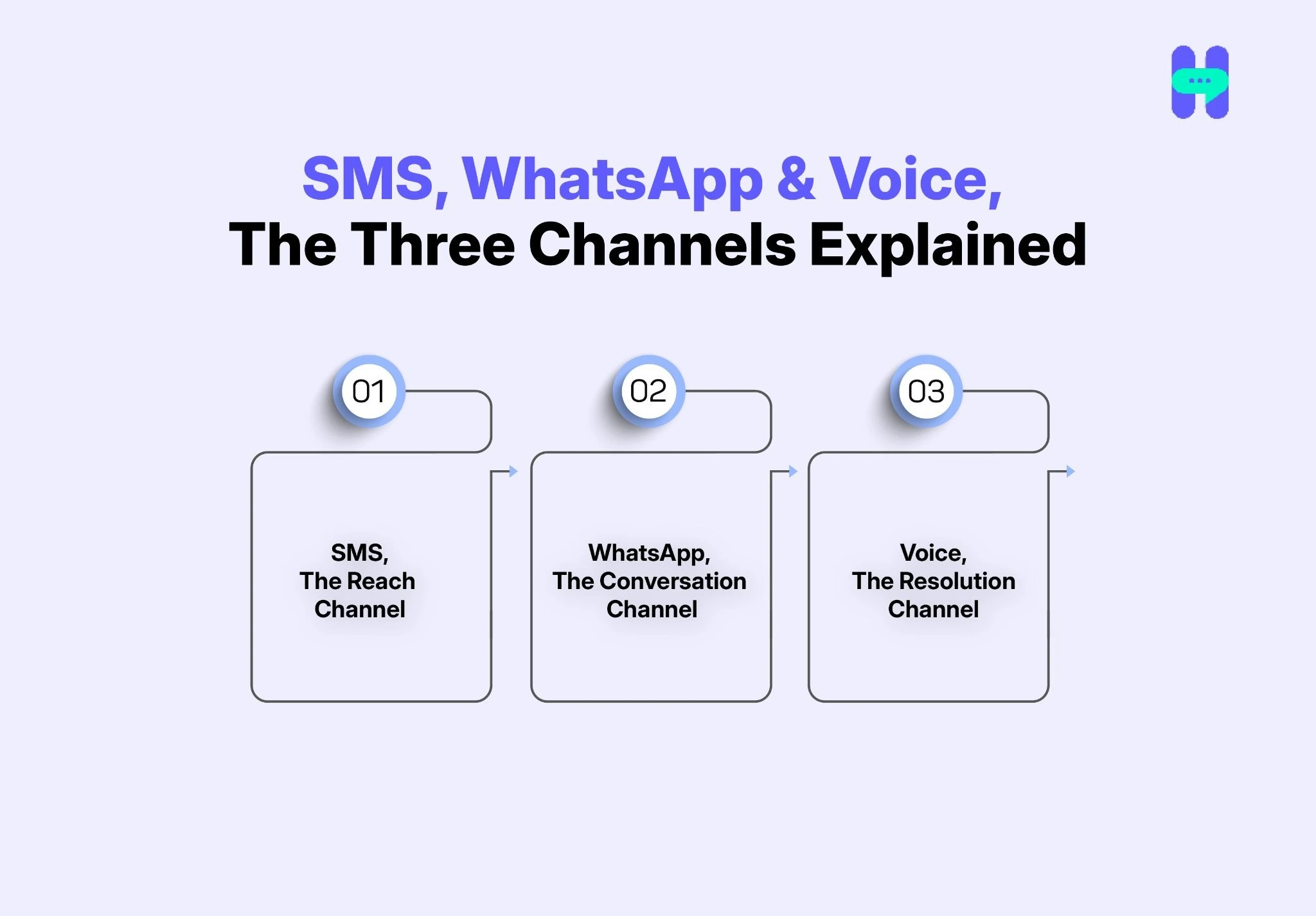
SMS, WhatsApp & Voice, The Three Channels Explained
Each of these three channels has a distinct role in the customer journey. None of them can fully replace the others, and that is precisely why unifying them matters.
SMS, The Reach Channel
SMS does not need the internet. It reaches every mobile device, anywhere in the world, regardless of smartphone capability or data availability.
It is best used for alerts, OTPs, appointment reminders, delivery notifications, and short-form updates. Its strength is universal reach and near-perfect deliverability. Its limitation is just as clear: no media support, a strict character limit, and very little room for two-way conversation.
SMS text is where you reach customers. It is not where you resolve their problems.
WhatsApp, The Conversation Channel
WhatsApp supports images, documents, buttons, quick replies, and rich media, making it the natural home for two-way customer conversations. With over 2 billion users globally and open rates ranging from 90 to 98%, it is the most engaged messaging channel available to businesses today.
It is best suited for customer support conversations, follow-ups, sales queries, and proactive notifications. The limitation is that it requires an internet connection, and businesses need access to the WhatsApp Business API to use it at scale.
WhatsApp is where you have conversations. It is not where you resolve complex, high-stakes issues. Using WhatsApp marketing services will provides you better results.
Voice, The Resolution Channel
Some problems cannot be solved with a text message. Frustrated customers, complex technical issues, and high-stakes situations all benefit from a real human voice. Voice calls offer clarity, empathy, and real-time problem-solving that no text channel can fully replicate.
Its limitation is convenience, not every customer wants to be on a call, and there is no written record unless the call is transcribed. But for escalations and resolutions, Voice remains irreplaceable.
Voice is where you resolve. It is not where you reach or nurture.
How SMS, WhatsApp & Voice Work Together in One Platform
Here is where the real power emerges. Consider this customer journey:
- A customer receives an SMS alert notifying them of a delayed shipment
- They open WhatsApp to ask for more details and share a screenshot of their order
- The agent, seeing the complexity of the issue, initiates a Voice call directly from within the same conversation thread
- After the call, an automated WhatsApp message is sent summarizing what was discussed and the resolution steps
The customer never had to repeat themselves. The agent never had to switch tools. The entire journey lived in one platform.
This is the strategic power of unifying SMS, WhatsApp, and Voice, each channel plays its role, at the right moment, in the right context.
How to Choose the Right Platform for Your Business
The market has no shortage of platforms. What it lacks is clarity on how to evaluate them. Use this checklist when comparing your options:
- Does it natively support SMS, WhatsApp, and Voice, or does it rely on third-party middleware to connect them?
- Is there a unified inbox where all agents can manage every channel from one screen?
- Does it integrate with your existing CRM so customer data flows automatically into every conversation?
- Can it scale with your conversation volume as your business grows, without requiring a complete workflow rebuild?
- Does it offer automation and smart routing so the right message reaches the right agent at the right time?
- Is pricing transparent, do you pay per user, per message, or per conversation, and does it make sense at your current volume?
HelloSend: The Best Omnichannel Customer Communication Tool
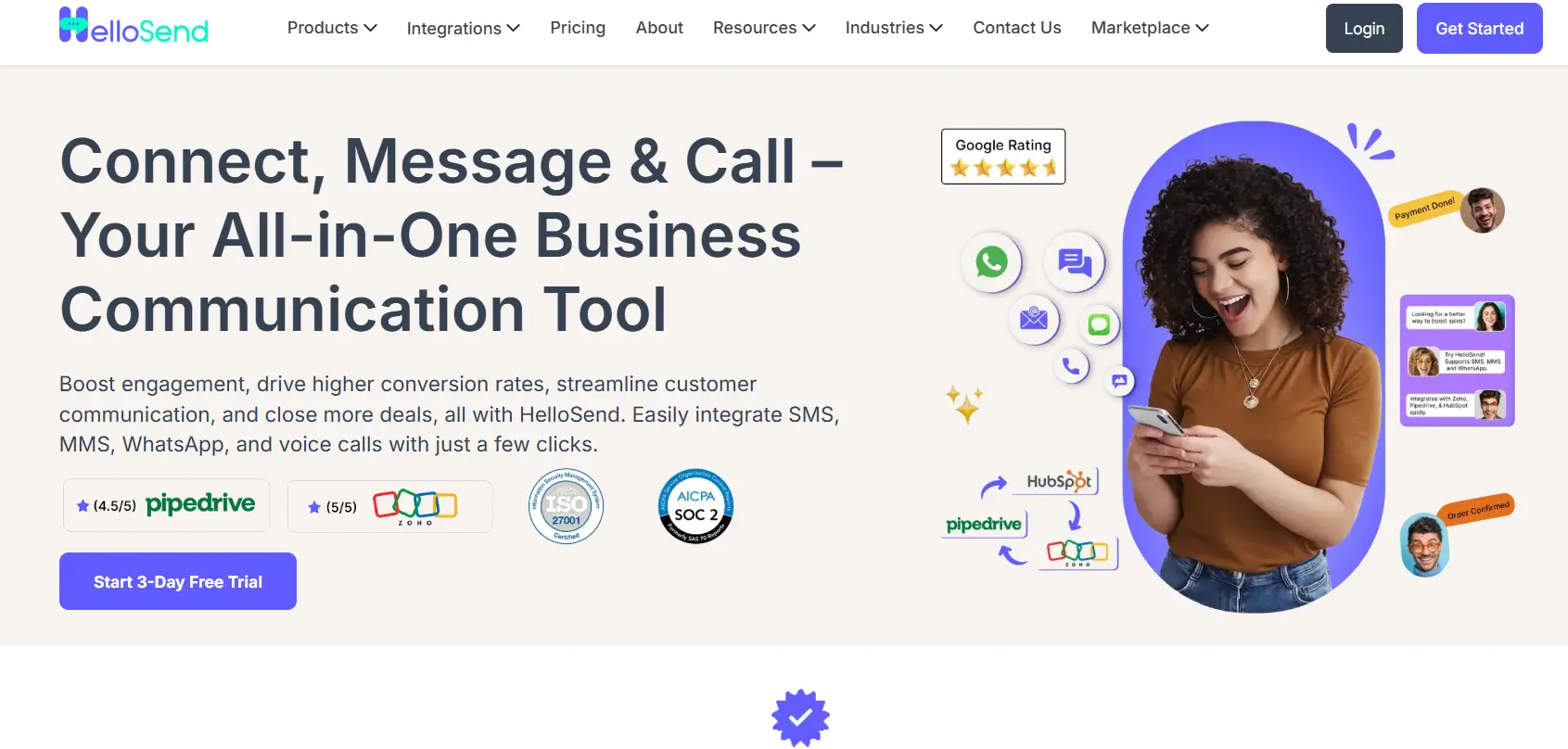
Best for: Businesses that want a messaging-first omnichannel platform to improve customer experience across SMS, WhatsApp, and voice calls, all from inside their CRM.
HelloSend is built for businesses that understand one fundamental truth: communication is the foundation of customer experience. If your messages are not reaching customers on the right channel, at the right time, with the right context, everything else falls apart.
What makes HelloSend different is not just the channels it supports, but also how deeply it integrates those channels into the workflows your team already uses.
HelloSend connects natively with HubSpot, Salesforce, Zoho CRM, and more, meaning your sales reps, support agents, and marketers never have to leave their CRM to communicate with customers. Explore more about HelloSend Integrations.
Here's what HelloSend brings to the table:
Key Features Of HelloSend
For teams in real estate, Information Technology (IT) and many more, HelloSend is the fastest path from fragmented communication to a genuinely connected customer experience.
Who Needs an Omnichannel Customer Communication Platform?
If your business interacts with customers across more than one channel, you need this. But some industries feel the gap more acutely than others.
- E-commerce and retail brands deal with high volumes of order queries, returns, and delivery updates across WhatsApp, SMS, and phone simultaneously.
- Healthcare providers send appointment reminders via SMS, handle patient queries on WhatsApp, and manage urgent cases over Voice, all requiring connected context.
- Financial services teams operate in compliance-sensitive environments where every conversation must be logged, traceable, and contextual across channels.
- SaaS companies manage onboarding, support, and renewal conversations across multiple touchpoints and need a unified view to prevent churn.
- Logistics businesses send delivery alerts via SMS, handle exceptions on WhatsApp, and escalate critical situations via Voice, often within the same customer interaction.
A platform that checks all six boxes is one that will grow with your business, not limit it.
Conclusion
SMS, WhatsApp, and Voice each do something the others cannot. But when they operate in isolation, they create the very frustration businesses are trying to eliminate. Omnichannel customer communication is what turns three separate tools into one connected experience, for customers who never have to repeat themselves, and for teams who always know the full story. It also boosts customer engagement.
The businesses winning at customer experience today are not the ones using the most channels. They are the ones connecting them. If your communication is still fragmented, the next step is understanding what a unified platform actually looks like in practice, and which one fits your business best.
FAQs
1. What is omnichannel customer communication and how is it different from regular customer support?
It connects all channels, SMS, WhatsApp, Voice, into one continuous conversation, so customers never repeat themselves and agents always have full context.
2. Can small businesses benefit from an omnichannel customer communication platform?
Yes. Even with a small team, a unified platform reduces missed messages, saves time, and creates a more professional customer experience.
3. Is WhatsApp better than SMS for business communication?
They serve different purposes. WhatsApp is better for rich, two-way conversations. SMS is better for reach and delivery where internet access is limited. A unified customer communication platform uses both strategically.
4. How does a unified business communication platform handle Voice calls alongside messaging?
A business communication platform logs calls, links them to the customer's message history, and makes everything visible to any agent, so Voice becomes part of the same conversation thread, not a separate interaction.
5. What is the first step for a business looking to move to omnichannel customer communication?
Start by auditing which channels your customers already use to reach you. Then look for a platform that natively connects those channels, starting with SMS, WhatsApp, and Voice.


.webp)


.webp)
