


Summarize this blog post with:
Quick Summary
Discover how Omnichannel Automation helps businesses unify SMS, WhatsApp, and voice into one powerful workflow. Learn proven strategies to boost engagement, automate customer conversations, reduce response time, and increase conversions in 2026.
A customer discovers your business at 9:14 AM. They fill out a form, get an SMS instantly, continue the conversation on WhatsApp, and book a call within minutes. Everything feels smooth until the sales agent asks, “Can you explain your requirement again?”
That single question kills momentum faster than most businesses realize.
In 2026, customers do not care which channel they started on. They expect every interaction to feel connected, personal, and continuous. But most companies still run SMS, WhatsApp, and voice calls in separate systems that never share context.
The result? Repeated conversations, slower responses, frustrated leads, and lost revenue. Due to this customer relation is also broken.
That is exactly why Omnichannel Automation has become a competitive advantage, not just a tech upgrade.
This guide breaks down how modern businesses are unifying SMS, WhatsApp, and voice into one seamless workflow that keeps conversations, customer context, and conversions moving together.
Why Omnichannel Automation Gives Better Results?
Omnichannel Automation delivers better results because every customer interaction stays connected across SMS, WhatsApp, email, and voice. Teams get complete conversation history in one place, which reduces response time, improves personalization, and prevents leads from dropping during channel switches.
Instead of managing disconnected tools, businesses create one continuous customer journey that increases customer engagement, conversions, and retention.
- Faster response times across every communication channel
- Higher conversion rates through personalized conversations
- Fewer dropped leads caused by disconnected customer data
- Better customer experience with seamless cross-channel communication
Omnichannel vs. Multichannel: The Difference That Actually Matters
The omnichannel customer experience is not a luxury feature in 2026. It is the baseline expectation of any buyer who has ever had a good customer experience,and that is most of them.
Omnichannel Messaging Automation: How SMS, WhatsApp & Voice Work Together
Most businesses treat SMS, WhatsApp, and voice as three separate channels competing for the same customer's attention. The smarter framing is this: each channel has a specific job to do at a specific moment in the customer journey. This also improves customer retention.
The workflow's role is to hand the customer from one channel to the next, at exactly the right moment, with full context intact.
Here is how each channel fits into that structure.
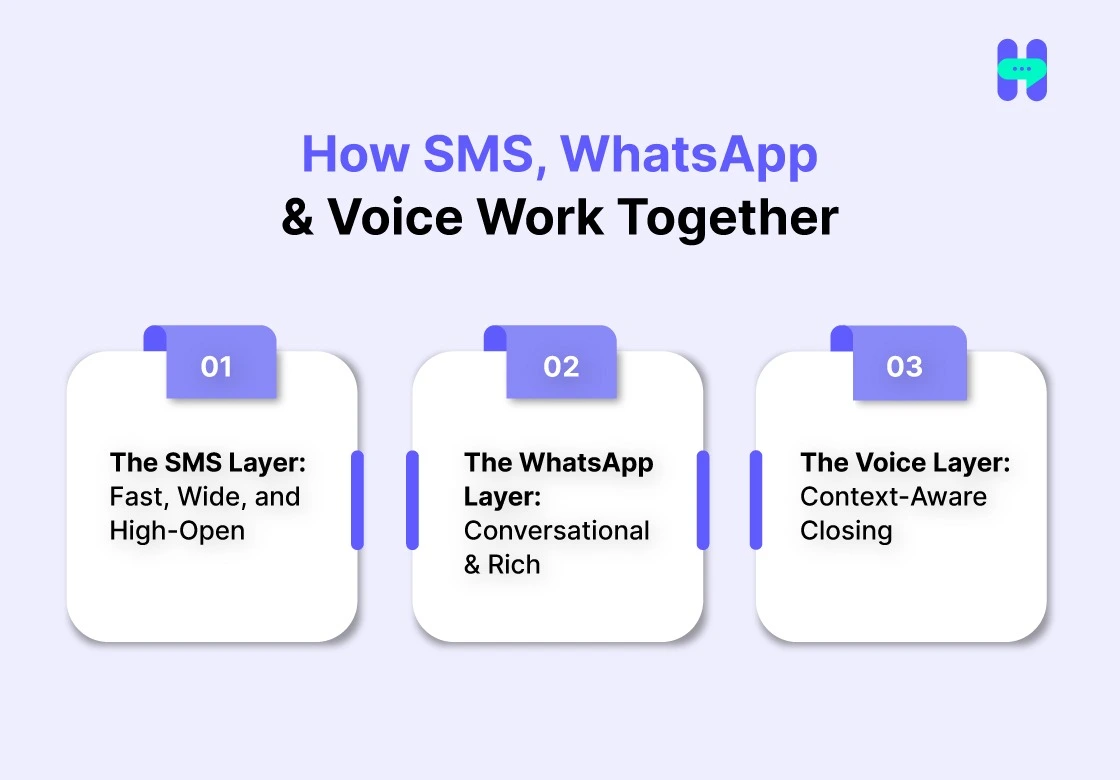
1) The SMS Layer: Fast, Wide, and High-Open
SMS automation sits at the top of the omnichannel messaging automation workflow for one reason: speed and reach. SMS open rates sit at 98%, most within the first three minutes of delivery.
- No other channel gets a customer's attention faster. This makes SMS the right tool for the first touch,the moment a lead enters your workflow, submits a form, clicks an ad, or abandons a cart.
- SMS is not a conversation tool. It is an attention and trigger tool. Its job is to get the customer to engage,to reply, to click, to confirm. Once they do, the workflow moves them forward. SMS also handles the compliance groundwork: opt-ins, unsubscribe handling, and delivery confirmation are all managed automatically in a well-built sms automation system.
2) The WhatsApp Layer: Conversational & Rich
Once the customer responds,or once the SMS trigger logic determines they are ready for a richer interaction,WhatsApp takes over. WhatsApp is the qualification engine of the omnichannel workflow.
- It supports two-way conversation, images, documents, buttons, and voice notes. It is where you learn who your customer is, what they want, and whether they are worth routing to a voice call. And Whatsapp automation makes work more easier to reach your target audience.
- A WhatsApp bot built into an omnichannel messaging automation system can ask qualifying questions, present options, collect information, and log everything to the shared customer record,all without a human agent. When it detects a qualifying threshold has been met (a pricing question, a demo request, a high-intent keyword), it flags the customer for the next stage: voice.
3) The Voice Layer: Context-Aware Closing
Voice is where the deal is made or lost. It is the highest-intent, highest-effort channel in the stack,which means it should be used precisely, not broadly. A voice call should only happen when the customer is qualified and the agent or AI voice system already knows everything the SMS and WhatsApp exchanges captured.
- In a true omnichannel system, the voice agent,human or AI,opens the call with full context. They know the customer's name, their stated problem, their timeline, their budget range, and their prior objection if there was one. The call picks up mid-conversation, not at the beginning.
- For outbound voices in the US, TCPA compliance is non-negotiable. This means honoring Do Not Call lists, obtaining prior express consent for automated calls, and respecting calling hour windows. A well-built omnichannel platform automates all of this at the dialer level.
HelloSend: Best Solution For Omnichannel Messaging Automation
Most businesses are not struggling with lead generation. They are struggling with fragmented communication. A prospect replies on SMS, continues on WhatsApp, expects a callback, and suddenly your team is juggling disconnected tools, missing context, and losing momentum.
That is where Omnichannel Automation changes everything.
HelloSend unifies SMS, WhatsApp, and voice calls support into one automated workflow, giving your team a complete view of every customer conversation in real time. It connects directly with your CRM, automates follow-ups, routes conversations intelligently, and helps sales teams respond faster without losing context.
Top Features
Benefits of Omnichannel Messaging Automation
1. Higher Response Rates Across Every Stage: SMS open rates sit at 98%. WhatsApp response rates exceed 60% in conversational flows. Voice connects when context is already established. Running all three in a coordinated sequence means your messages land in the right place at the right moment,not as interruptions, but as continuations.
2. Faster Lead Qualification Without Adding Headcount: A WhatsApp bot embedded in your omnichannel messaging automation workflow can qualify a hundred leads simultaneously while your team sleeps. By the time a human touches a lead, the lead is pre-qualified, pre-scheduled, and pre-informed. Time to meaningful conversation drops from days to hours.
3. Zero Context Loss Across Channel Switches: When context carryover works correctly, the customer never repeats themselves. That alone reduces friction significantly. Customers who feel understood are measurably more likely to convert,not because they were sold to better, but because they were respected. That’s why many business prefer to use omnichannel messaging platform.
4. Lower Cost-Per-Contact at Scale: Automated SMS, WhatsApp sequences, and AI voice agents handle repetitive outreach at a fraction of the cost of human agents doing the same work. As volume grows, cost-per-contact stays flat or decreases,the opposite of what happens with human-only outreach.
5. Compliance Automation Built Into the Workflow: A properly built omnichannel automation stack handles TCPA consent for voice, WhatsApp API template enforcement, SMS opt-out processing, and DNC list scrubbing automatically. Compliance is no longer a manual audit,it is a workflow feature.
6. Scalability Without Structural Change: The same workflow that handles fifty leads a week can handle five thousand. The architecture does not change. The team does not scale proportionally. This is the core economic argument for omnichannel messaging automation,it breaks the linear relationship between growth and headcount.
Conclusion
Omnichannel automation in 2026 is not a marketing buzzword and it is not a technology trend. It is a structural decision about how your business handles the moment a customer moves from one channel to another,and whether that moment feels seamless or broken.
The workflow this guide walked through is not complicated in concept. SMS starts the conversation. WhatsApp qualifies it. Voice closes it. The CRM remembers all of it. Every channel feeds the next one. The customer never starts over.
Try HelloSend to make your omnichannel automation work more efficiently. Connect with us today. Book 3 days free trial. No credit card needed!
FAQs
1. What is omnichannel automation?
Omnichannel automation is the process of connecting channels like SMS, WhatsApp, email, and voice into one unified communication workflow. It helps businesses automate customer interactions across every channel while keeping conversations, data, and context synchronized in real time.
2. Can SMS, WhatsApp, and voice calls be automated in a single platform?
Yes,platforms like EchoLeads, Bird, and Twilio support all three channels natively. The key differentiator is whether the platform maintains shared conversation context across channels or simply manages them from one dashboard.
3. What compliance rules apply to omnichannel messaging automation in 2026?
SMS and voice are governed by TCPA in the US, requiring prior express consent and DNC list adherence. WhatsApp requires official Business API access and enforces template approval for messages sent outside the 24-hour conversation window. A properly built omnichannel stack automates all of these.
4. How does context carryover work when a customer switches from WhatsApp to a voice call?
In a true omnichannel system, every WhatsApp message is logged to a unified customer record in real time. When the voice call fires, the agent,human or AI,reads from that same record. The call begins with full context from all prior interactions already loaded.
5. Which industries benefit most from omnichannel messaging automation?
SaaS, e-commerce, real estate, healthcare, and financial services see the highest returns,all are industries where lead qualification is multi-step, follow-up timing is critical, and customer trust is built through consistency of experience across multiple touchpoints.

.webp)


.webp)
