


Summarize this blog post with:
Quick Summary
Explore how omnichannel marketing platforms enable e-commerce and real estate businesses to increase conversions, improve customer experience, and manage all communication channels from one place.
Your customer finds your product on social media, abandons the cart, ignores your email, and then buys from a competitor that follows up via WhatsApp or SMS. Sound familiar?
This is not a lead quality problem. It is a disconnected marketing problem.
Today's buyers, whether they are shopping for sneakers or a three-bedroom apartment, constantly move across channels. They expect every interaction to feel like one continuous conversation, not five separate ones from five different tools.
Omnichannel Marketing Platforms solve this by unifying all channels, email, SMS, WhatsApp, social media, and your website, into a single, intelligent customer journey. No repetition. No contradictions. No leads left behind.
E-commerce brands use them to recover carts, drive repeat purchases, and build loyalty. Real estate teams use them to nurture leads from the first click to a signed deal.
In this blog, you will learn how they work, what they deliver, and which platform deserves your investment.
Why E-Commerce and Real Estate Need Omnichannel Marketing Platforms
At first glance, e-commerce and real estate seem like very different businesses. One sells products in seconds; the other closes deals over months. But both share the same core challenge: customers move across multiple channels before they convert, and businesses that cannot follow that journey consistently lose to those that can.
E-Commerce: Meeting the Always-On Shopper
Today's online shopper does not follow a straight path from discovery to purchase. They discover a product on Instagram, read reviews on Google, add it to their cart on your website, get distracted, and move on. Without a system in place to bring them back, and bring them back with the right message, that sale is gone.
- Research shows that companies with strong omnichannel engagement strategies retain an average of 89% of their customers, while those with weaker strategies retain only a much lower percentage.
- Omnichannel marketing platforms solve this by unifying product discovery, cart recovery, post-purchase follow-ups, and loyalty campaigns into one coordinated workflow. Every interaction builds on the last one, and no lead is left cold.
Real Estate: Bridging Digital Discovery and Physical Decisions
Real estate buyers typically spend weeks, sometimes months, researching online before they ever contact an agent. They scroll through listings on property portals, watch walkthrough videos on YouTube, fill out inquiry forms at midnight, and expect a timely, personalized response the next morning.
- Without omnichannel marketing platforms, most agencies handle this with a patchwork of tools, a CRM here, a WhatsApp thread there, an email newsletter sent separately. The result is a disjointed experience that makes the agency look disorganized and leaves the buyer feeling like a number.
- Omnichannel marketing platforms keep agents top of mind at every stage through coordinated email, WhatsApp Messages, SMS, and retargeting, all triggered by the buyer's actual behavior.
Key Benefits Of Using Omnichannel Marketing Platforms

1. Unified Customer View Across All Channels
One of the most immediate and impactful benefits of omnichannel marketing platforms is the creation of a single, unified customer profile. Instead of data sitting in separate tools, your email platform, your CRM, your WhatsApp inbox, your social ads manager, everything feeds into one place
This means your team always knows what a customer has seen, what they have clicked, what they have asked, and where they are in their journey.
2. Higher Engagement and Conversion Rates
When your messaging is coordinated across channels, engagement improves naturally. Customers receive messages relevant to where they are in their journey, delivered through their preferred channel at the time they are most likely to respond. This is one of the best customer engagement strategies.
Omnichannel marketing platforms make this possible by enabling real-time decision-making, autonomously managing customer interactions across email, WhatsApp, your website, and mobile without requiring your team to manually trigger every message. The result is a faster, more responsive customer experience that drives measurably higher conversion rates across both e-commerce and real estate contexts.
3. Personalization at Scale
Personalization is no longer a differentiator; it is an expectation. Customers expect brands to remember them, understand their preferences, and communicate accordingly. The challenge for growing businesses is delivering that level of personalization without a team large enough to do it manually.
Omnichannel marketing platforms address this through behavior-triggered workflows. In e-commerce, this refers to automated sequences that fire when a customer abandons a cart, repeatedly browses a category, or has not purchased in 60 days. In real estate, it means automated follow-ups when a lead fills out a property inquiry form, views a listing more than once, or goes quiet after an initial consultation.
4. Better ROI Measurement
Most businesses that rely on last-click attribution are making budget decisions based on incomplete data. They credit the final touchpoint, often a branded search or a direct website visit, while ignoring the email, the WhatsApp message, and the social ad that built the relationship over the previous three weeks.
Omnichannel marketing platforms replace last-click attribution with multi-touch attribution, giving you a complete picture of what is actually driving revenue. You can track improvements in conversion rates, customer lifetime value, average order value, and revenue attributed to each campaign, while also measuring the efficiency gains from automation and consolidated tooling.
5. Scalability for Growing Teams
As your e-commerce store adds more products and your real estate agency adds more agents, your marketing complexity grows exponentially. Managing that growth with manual processes is unsustainable.
Omnichannel marketing platforms are built to scale. Automated workflows handle the repetitive, high-volume tasks, welcome sequences, drip campaigns, re-engagement flows, and post-visit follow-ups without requiring additional headcount.
How Omnichannel Marketing Platforms Actually Work?
Understanding the mechanics helps you appreciate why these platforms produce results that disconnected tools simply cannot replicate.
Think of it as one brain running all your channels simultaneously.

Step 1: Customer data is collected from every touchpoint, your website, social ads, email campaigns, WhatsApp conversations, and CRM, and consolidated into a single, real-time customer profile.
Step 2: Behavioral triggers activate personalized messaging based on what that customer actually does. A visitor who abandons a cart triggers an SMS. If they do not respond within 24 hours, a WhatsApp message follows. If they still have not converted, an email with a discount or social proof fires automatically.
Step 3: Campaign delivery is synchronized across all channels so that no customer receives a contradictory or repetitive message. The platform manages sequencing, timing, and channel selection based on the rules you define and the behavior it observes.
Step 4: Analytics close the loop. After every campaign cycle, you can see exactly what worked, what did not, and where customers are dropping off. These insights feed back into your strategy, making every subsequent campaign smarter than the last.

Top 3 Omnichannel Marketing Platforms For E-Commerce And Real Estate Comparison table
1. HelloSend: Best for CRM-Integrated SMS, WhatsApp and Voice
Most businesses are not losing leads because of bad products. They are losing them because of slow, disconnected follow-ups.
HelloSend fixes that. It brings SMS, WhatsApp, and voice calls into a unified platform, plugs directly into your CRM, and automates every follow-up so your team can focus on closing, not chasing. For e-commerce and real estate, it is the communication engine your growth has been missing.
Top Features
- Omni-Channel Campaign Management: Run coordinated SMS, WhatsApp, and voice campaigns simultaneously from a single interface, so your messaging stays consistent, timely, and perfectly sequenced across every channel your customer touches.
- Unified Inbox: Bring every customer conversation, SMS, WhatsApp, and voice, into one single dashboard so your team never switches between tools, never loses context, and never lets a lead go unanswered.
- Deep CRM Integrations: Connect natively with Salesforce, HubSpot, Zoho CRM, Pipedrive, and Zendesk so every message is automatically logged against the right contact, keeping your pipeline accurate and your team aligned without a single manual entry.
- Automated Messaging Workflows: Build behavior-triggered sequences across SMS, WhatsApp, and voice that run on autopilot, so your leads are followed up, your carts are recovered, and your inquiries are answered even when your team is offline.
- Two-Way WhatsApp Conversations: Go beyond one-way broadcast messages and hold real, personalized conversations with leads directly inside the platform, so every interaction feels human, builds trust, and moves the relationship closer to a conversion.
- Real-Time Analytics Dashboard: Track delivery rates, response rates, and conversion performance across every channel from one reporting view, so your team always knows what is working, what is not, and exactly where to optimize next.

2. Omnisend

Omnisend is one of the most specialized omnichannel marketing platforms on the market, built exclusively for e-commerce businesses. Unlike general-purpose marketing tools that try to serve every industry, Omnisend is designed around the specific workflows, goals, and metrics that matter to online retailers.
Features
- Pre-built automation workflows for cart abandonment, order confirmations, and post-purchase follow-ups are useful for standard e-commerce sequences but limited in flexibility once you move beyond basic retail scenarios.
- A campaign builder that combines email, SMS, and web push notifications in one place, it covers the essentials for online stores but does not extend well into conversation-led channels like WhatsApp or voice.
- Revenue reporting dashboard that tracks campaign performance and order data, functional for measuring email and SMS results, but requires additional tools if you need a broader view of your customer communication history.
3. ActiveCampaign
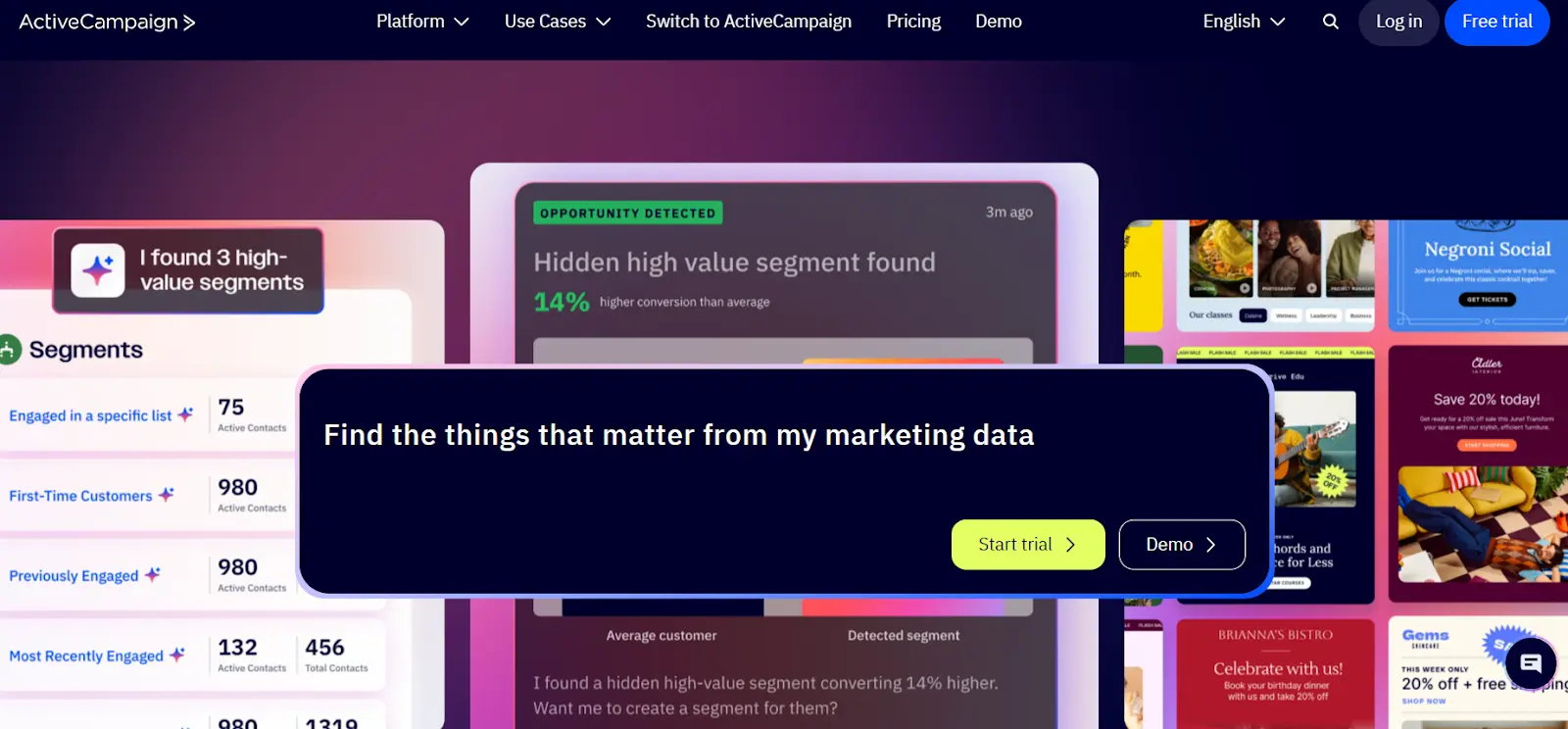
ActiveCampaign is an all-in-one omnichannel marketing platform that combines email marketing, a built-in CRM, and advanced customer experience automation into one system. It is particularly well-suited for businesses that have outgrown basic email tools but do not yet need or want to pay for enterprise-level platforms.
Key Features
- A visual automation builder with pre-made templates and trigger-based workflows works well for straightforward email journeys, but can become complicated to manage as your sequences grow more complex.
- A built-in CRM with basic pipeline management handles lead tracking and task assignments adequately, though teams with heavier communication needs may find it lacks the depth of a dedicated CRM integration.
- AI-powered segmentation that builds audience groups based on behavior and campaign data, helpful for email targeting, but does not meaningfully extend into real-time, cross-channel conversation management.
Final Thoughts
In both e-commerce and real estate, fragmented marketing costs sales. When your email platform does not know what your WhatsApp has said, and your CRM does not know what your ads have shown, you create a customer experience that feels inconsistent, impersonal, and unreliable, and customers notice.
Omnichannel marketing platforms solve this by turning every touchpoint into a single, seamless, intelligent journey. They give your team the data, automation, and channel reach to consistently engage the right person with the right message at the right moment, at scale.
Whether you are managing a Shopify store or a growing property portfolio, the right omnichannel marketing platform can fundamentally transform how you attract, nurture, and convert customers. The businesses investing in these platforms today are the ones that will define their industries tomorrow.

Frequently Asked Questions
1. What is the difference between multichannel and omnichannel marketing platforms?
Multichannel means being present on multiple channels. Omnichannel means that channels are connected, sharing data and coordinating messaging so the customer experiences a single, consistent journey regardless of where they engage.
2. Can omnichannel marketing platforms work for small real estate businesses?
Yes. Most platforms offer scalable pricing and pre-built workflows that do not require a large marketing team to operate. Even a small agency with a few agents can benefit significantly from automated follow-ups and unified lead tracking.
3. How long does it take to see results from an omnichannel marketing strategy?
Most businesses begin seeing improvements in engagement and lead response rates within the first 30 to 60 days of implementation. Significant revenue impact typically becomes measurable within three to six months as automation workflows optimize.
4. Do omnichannel marketing platforms integrate with existing CRM tools?
Yes. Most leading platforms, including HelloSend, Omnisend, and ActiveCampaign, offer native integrations with major CRMs such as Salesforce, HubSpot, Zoho, and Pipedrive, allowing your existing data to flow directly into your marketing workflows.
5. Which omnichannel marketing platform is best for e-commerce beginners?
Omnisend is generally the most beginner-friendly option for e-commerce, thanks to its pre-built automation templates, intuitive interface, and deep integration with Shopify and WooCommerce that requires minimal technical setup.


.webp)


.webp)
