

Summarize this blog post with:
Quick Summary
Discover the best Customer Engagement Strategies for SaaS businesses, from onboarding and personalization to retention tactics that reduce churn and drive long-term growth.
Acquiring a new customer costs five times as much as retaining an existing one. For SaaS businesses running on subscription revenue, that stat isn't just interesting; it's a warning.
Most SaaS teams pour their energy into acquisition. But the moment a user signs up, the real work begins. Without consistent, meaningful engagement, even your best-fit customers go quiet, stop logging in, and eventually churn, taking their MRR with them.
That's where customer engagement strategies come in. The right strategies keep your users active, help them realize value faster, reduce churn, and turn satisfied customers into advocates who grow your pipeline for you.
This blog breaks down the top customer engagement strategies built specifically for SaaS businesses, what they are, why they work, and how to put them into practice. Whether you're an early-stage startup or a scaling SaaS team, there's something here you can act on today.
What Are Customer Engagement Strategies?
Customer engagement strategies are structured, intentional approaches to building ongoing relationships between a SaaS business and its users, across every stage of the customer lifecycle.
- In SaaS, this goes far beyond marketing campaigns or support tickets. Because your customers pay on a recurring basis, engagement isn't a one-time event.
- It's a continuous process. Every interaction, from onboarding emails to in-app tooltips to renewal check-ins, either deepens the relationship or weakens it.
- Customer engagement strategies define how you communicate, when you show up, and what value you deliver at each touchpoint.
- Done well, they make your product feel indispensable. Done poorly, or not at all, they leave users wondering why they're paying for something they barely use.
Top 07 Customer Engagement Strategies For SaaS Businesses

1. Personalize the Onboarding Experience
Onboarding is the single most important engagement moment in the SaaS customer journey. It's where users decide whether your product is worth their time or their money.
Personalized onboarding means tailoring the experience to each user's role, goal, and use case from the moment they sign up. Instead of showing everyone the same generic walkthrough, you segment users by job title, company size, or stated objective and guide them toward the features most relevant to them.
2. Use In-App Messaging and Contextual Nudges
The best time to engage a user is when they're already inside your product. In-app messages, tooltips, banners, modals, and checklists let you deliver guidance, announcements, and prompts at exactly the right moment, without pulling users out of their workflow.
Contextual nudges are especially powerful for feature adoption. If a user hasn't discovered a feature that would solve a problem they clearly have (as evidenced by their behavior), a well-timed tooltip can bridge that gap instantly.
3. Build a Customer Education Program
Users who understand your product engage with it more. It's that simple. A structured customer education program, covering knowledge bases, video tutorials, live webinars, and certification courses, gives users the resources to get value on their own terms, at their own pace.
For B2B SaaS specifically, education also serves the power users and champions inside a customer's organization, the people who will advocate for renewing your contract at budget time.

4. Leverage SMS and WhatsApp Automation
Generic broadcast messages don't drive engagement; they get ignored. SMS texts and WhatsApp automation send messages based on what a user actually does (or doesn't do) inside your product, making every touchpoint feel timely and relevant rather than random.
A user who hasn't logged in for 14 days needs a different message than one who just completed their first key action. With SMS and WhatsApp automation, you can send the right message to the right person at the right moment, on the channels with 98%+ open rates, at scale.
5. Create a Customer Community
A product community gives your users a place to connect with each other, share use cases, ask questions, and feel part of something bigger than a software subscription. For SaaS businesses, this is one of the highest-leverage engagement plays available, because the community creates value that your product alone can't.
When users help each other solve problems, share templates, and celebrate wins within your community, their identities become tied to your platform. That's a powerful retention force.
6. Implement Customer Health Scoring
You can't improve what you don't measure. A customer health score is a composite metric that tells you, at a glance, how likely each account is to renew, expand, or churn, based on real behavioral data.
Health scoring combines signals like product usage frequency, feature adoption breadth, support ticket volume, NPS responses, and license utilization into a single score. It gives your CS team a prioritized view of who needs attention and who is ready for an upsell conversation.
7. Proactively Collect and Act on Feedback (NPS, CSAT)
Asking for feedback is an act of engagement in itself. It signals to customers that their experience matters, and that you're listening. But collecting feedback without acting on it is worse than not asking at all.
NPS (Net Promoter Score) tells you who loves your product enough to recommend it and who is silently at risk. CSAT (Customer Satisfaction Score) measures satisfaction at specific touchpoints, like onboarding or support interactions. Together, they give you a continuous pulse on the customer relationship.
HelloSend: The Best Customer Engagement Tool For SaaS Businesses
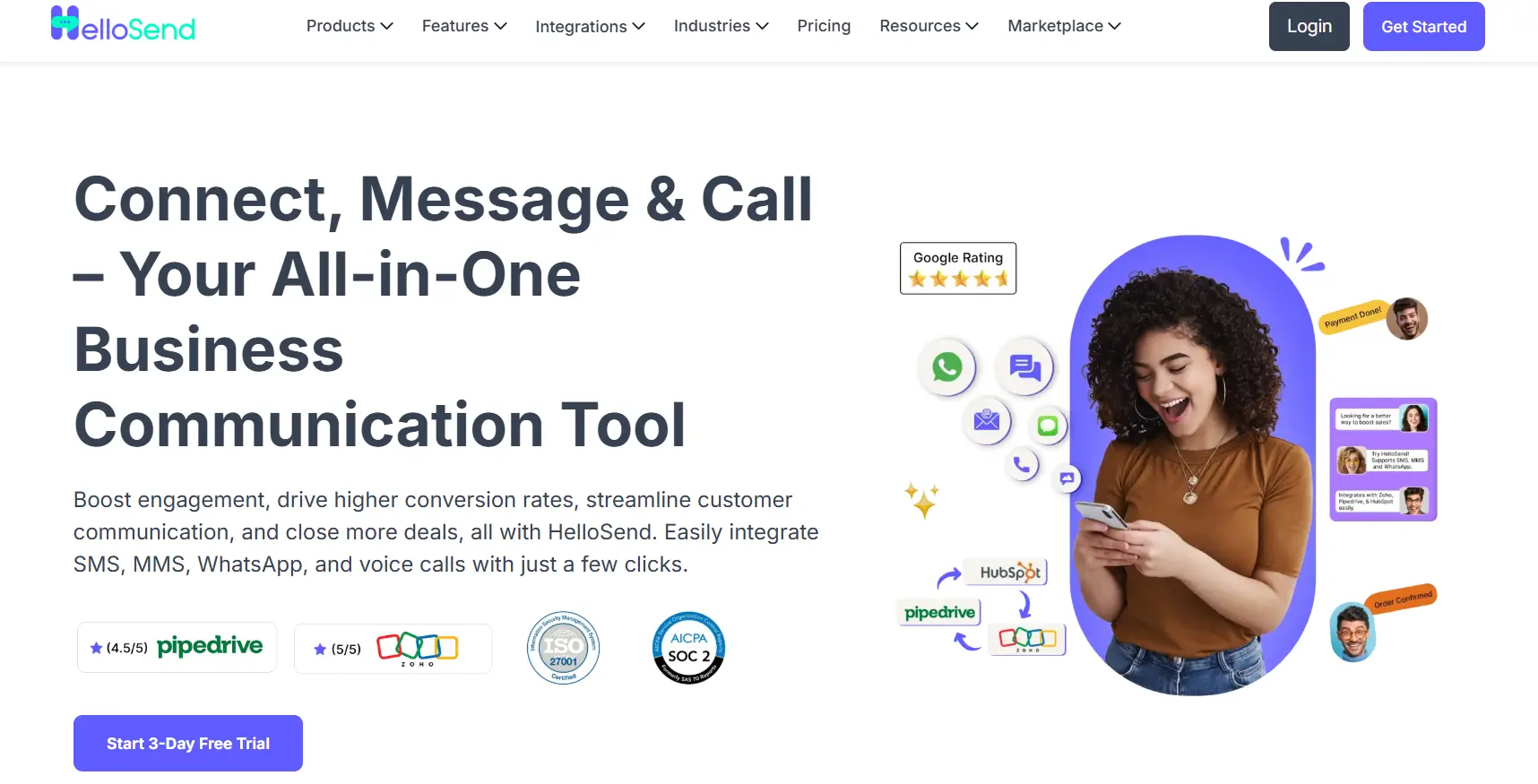
The right strategies only deliver results when the right tool is behind them. HelloSend is that tool. HelloSend is an all-in-one business communication platform that unifies SMS, WhatsApp, and Voice, purpose-built for SaaS teams who want to engage customers across every channel they actually use, all from a single dashboard.
Most SaaS teams are juggling three different tools to send an email, fire a WhatsApp message, and log a support call.
HelloSend eliminates that. It brings SMS, WhatsApp, and Voice into a single platform, directly connected to your CRM, so your team stops switching tabs and starts having conversations that actually move the needle.
Here's a breakdown of HelloSend's three core products and what each one does for your SaaS engagement:
Why Customer Engagement Matters for SaaS Businesses?
In a subscription model, revenue is earned every month. That means churn is always one bad experience away. Customer engagement is what stands between a healthy, growing MRR and a leaky bucket. By using the best strategies, your customer relations will improve.
Here's what strong engagement directly impacts for SaaS businesses:
- Churn reduction: Engaged users who consistently find value in your product are far less likely to cancel. Proactive engagement catches at-risk customers before they reach the cancellation page.
- Expansion revenue: Users who are deeply engaged are more likely to upgrade plans, adopt new features, and say yes to upsell conversations, because they already trust the product.
- Product adoption: Engagement drives users deeper into your product. The more features they use, the stickier your platform becomes and the harder it is to replace.
- Brand advocacy: Highly engaged customers become your most credible marketing channel, leaving reviews, referring peers, and participating in case studies without being asked twice.
In short, engagement is not a nice-to-have for SaaS. It's the engine that keeps the subscription model running.
Customer Engagement Best Practices for SaaS Teams
Most SaaS teams have the tactics. What separates high-performing teams is the discipline behind how they execute. These customer engagement best practices are the principles that keep your strategy from falling apart at the seams.
Engage With Purpose: More messages don't mean more engagement. Every touchpoint needs a clear reason to exist; if you can't define the value it delivers to the user, don't send it.
Lead With Outcomes: Users don't care what your product does. They care about what they can achieve with it. Frame every interaction around what the user gains, time saved, revenue grown, and problems solved.
Break The Silos: Engagement breaks down when teams operate in silos. Customer Success owns the relationship, marketing owns the message, and product owns the experience, but all three need to be working from the same playbook.
Personalize Beyond Names: Real personalization means adapting your message, timing, and channel based on user behavior and lifecycle stage, not just adding a first name token to a subject line.
Always Close Loops: Collecting feedback without acting on it erodes trust faster than not asking at all. When user input shapes a product decision, tell the users who gave it. That one habit builds more loyalty than any campaign.
What’s Next?
Customer engagement is not a campaign you run once; it's the system that keeps your SaaS business growing. When you combine the right customer engagement strategies with consistent execution across onboarding, in-app experience, automation, education, and feedback, you build something churn can't easily break: a product customers genuinely rely on.
For B2B SaaS teams, the opportunity is clear. Start with the strategies that match your current stage, build the frameworks that connect them, and invest in the tools that help you scale the human moments that matter most.
The businesses that win in SaaS are not the ones with the best product on paper; they are the ones whose customers never want to leave.

FAQs
1. What is the difference between customer engagement and customer experience in SaaS?
Customer experience is the overall perception a user has of your product and brand. Customer engagement is the active, ongoing interaction between your business and your users. Experience is the outcome; engagement is what drives it.
2. How do you measure customer engagement for a SaaS product?
Key metrics include DAU/MAU ratio, feature adoption rate, session frequency, NPS score, email open and click rates, and churn rate. Track these by segment to get an accurate picture of engagement health across your customer base.
3. What are the most common customer engagement mistakes SaaS companies make?
The most common mistakes are engaging too infrequently during the post-onboarding period, sending generic messages that aren't tied to user behavior, and failing to close the feedback loop after collecting NPS or CSAT data.
4. How often should SaaS businesses engage with their customers?
Slack sends personalized weekly activity digests, HubSpot runs a full certification academy tied to their product, and Intercom triggers behavior-based messages when users go quiet, all proven examples of engagement that reduce churn and drive adoption.
5. What makes a customer engagement strategy effective for SaaS?
An effective customer engagement strategy is built on three things: knowing your customer's lifecycle stage, delivering value at every touchpoint, and measuring outcomes, not just activity. Strategy without measurement is just guesswork.



.webp)
