


Summarize this blog post with:
Quick Summary
Managing WhatsApp chats manually is chaotic. A WhatsApp business CRM captures conversations, automates responses, and improves lead conversion and customer support efforts.
Your customers are already selling themselves to you on WhatsApp. They’re asking for pricing, requesting demos, confirming availability, and even negotiating all inside chat threads. WhatsApp now has more than 2.9 billion monthly active users worldwide.
That’s where buying decisions are happening. But here’s the problem.
Most businesses still treat WhatsApp like a casual inbox. Conversations live on personal devices. Leads are not logged in the CRM. Follow-ups depend on memory. Managers have no visibility into what’s moving or what’s stuck.
The result? Revenue gets trapped inside chats.
A proper WhatsApp business CRM closes that gap by connecting WhatsApp to your sales and support systems so every message moves a deal forward, not sideways.
In this blog, you will find all about WhatsApp CRM and the best solution for your business to make your work more easier. Let’s begin!
Why WhatsApp Conversations Don’t Scale Without A CRM?
Reason 1: Chat-First Selling Costs
Chat feels fast and personal, but without structure, it creates inconsistency. Every rep handles leads differently. No standard pipeline. No reporting. Growth depends on individuals instead of systems. As volume increases, chaos compounds. What worked for ten leads collapses when the number reaches one hundred.
Reason 2: Untracked Leads Leak
When WhatsApp conversations aren’t logged in a CRM, leads disappear into chat threads. No deal stages. No reminders. No accountability. Silent revenue loss becomes normal. Marketing drives traffic, but sales lack visibility. You invest in acquisitions while losing opportunities due to follow-up gaps.
Reason 3: Zero Performance Visibility
If conversations live in personal inboxes, managers can’t measure response times, conversion rates, or team efficiency. Without data, optimization is impossible, and growth becomes guesswork. There’s no way to identify bottlenecks, coach underperformers, or replicate winning sales behaviors across the team.
Reason 4: Follow-Ups Rely On Memory
Manual follow-ups depend on discipline. Busy reps forget. Messages get buried. Opportunities cool down. Without automation, pipeline momentum breaks and competitors respond faster. Deals rarely die instantly; they fade due to delayed responses and inconsistent engagement.
Reason 5: Sales Support Disconnect
Sales closes in chat, but support lacks context. Customers repeat themselves. Promises get lost. Friction increases. Poor handoffs directly impact retention and long-term loyalty. Without a shared history, internal teams operate blindly, undermining trust and damaging the overall customer experience. This will lose Customer Engagement.
The “Leads to Loyalty” WhatsApp CRM Framework
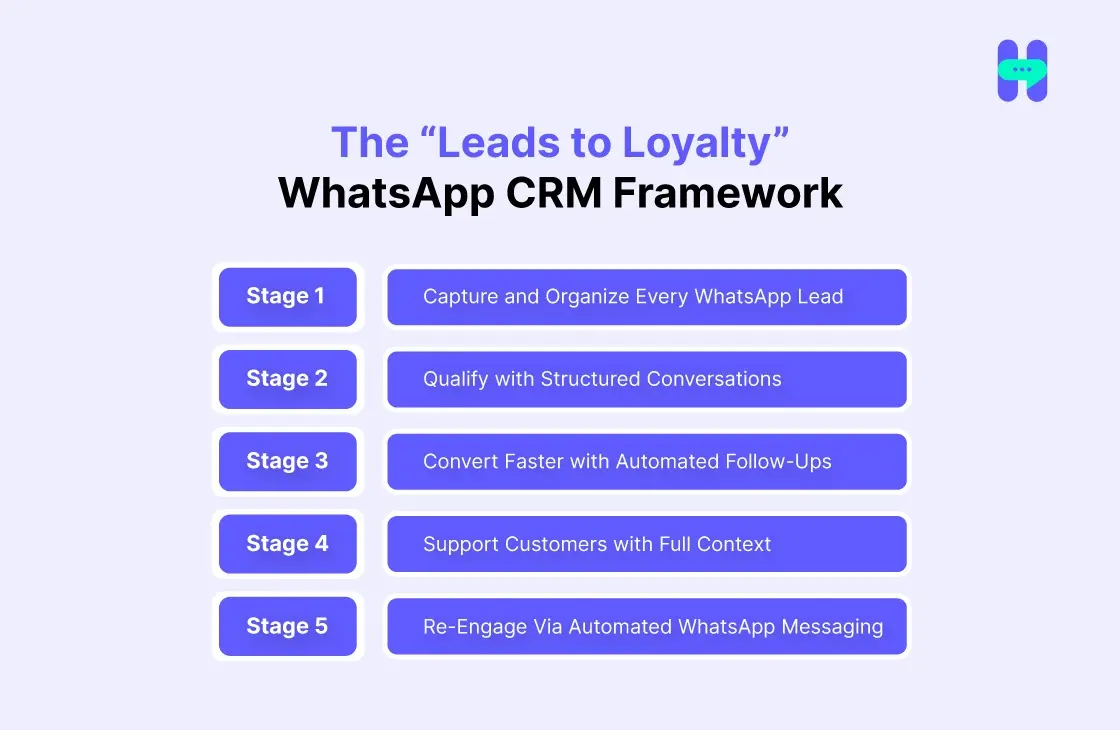
Most businesses use WhatsApp to talk. High-growth teams use it to manage a lifecycle.
A structured CRM integration with WhatsApp turns conversations into a clear journey from first message to repeat purchase. Here’s how that framework works in practice.
Stage 1: Capture and Organize Every WhatsApp Lead
Every new message should automatically create or update a contact inside your CRM. No manual entry. No lost chats. With proper WhatsApp business CRM integration, leads flow directly into your pipeline the moment a conversation starts.
Stage 2: Qualify with Structured Conversations
Not every lead is equal. Use tags, custom fields, and defined stages to consistently qualify prospects. Structured customer communication management ensures reps follow the same qualification process instead of improvising.
Stage 3: Convert Faster with Automated Follow-Ups
Speed closes deals. Smart automated WhatsApp messaging triggers reminders, proposal nudges, and payment confirmations at the right time. Follow-ups become systematic instead of dependent on memory. This will definitely boost Customer Retention.
Stage 4: Support Customers with Full Context
When support teams see past conversations, purchases, and internal notes, customers don’t repeat themselves. Context improves response quality and strengthens trust.
Stage 5: Re-Engage Via Automated WhatsApp Messaging
Growth doesn’t stop at conversion. With structured, automated WhatsApp messaging, you can send renewal reminders, reactivation campaigns, and personalized offers to increase lifetime value.
Lifecycle Overview
How WhatsApp CRM Software Improves Sales Performance?
Sales performance doesn’t improve because your team “tries harder.” It improves because your system operates more efficiently.
Here’s how it directly impacts revenue.
- Faster First Response Time = Higher Conversion: Speed wins deals. Research consistently shows that leads contacted quickly are significantly more likely to convert. When messages are routed instantly inside a WhatsApp business CRM, reps don’t miss high-intent inquiries.
- Structured Follow-Up Systems That Close Deals: Most deals don’t die because of rejection. They die because of silence. With built-in automated WhatsApp messaging, follow-ups are triggered based on time or deal stage, and reminders are sent. Nudges are sent. Conversations continue with customer messaging.
- Pipeline Visibility from Conversation to Revenue: Without integration, chats are disconnected from outcomes. With proper WhatsApp business crm integration, every conversation links directly to a deal stage. Managers can see how many WhatsApp conversations are active, qualified, negotiating, or closing.
- Sales Automation Without Losing Personalization: Automation should not feel robotic. Modern automated WhatsApp messaging allows personalization tokens, smart triggers, and behavior-based workflows. Messages feel human, but the timing is systematic.
What To Look For In A WhatsApp Business CRM
1) Native WhatsApp Integration
Look for seamless WhatsApp business CRM integration that syncs chats with your CRM. This ensures real-time updates, automated lead capture, and smooth data flow between WhatsApp and your sales pipeline.
2) Centralized Team Inbox
A shared inbox allows teams to manage conversations together. With proper access control, agents can collaborate, assign ownership, and avoid duplicate responses, ensuring accountability and better customer service.
3) Flexible Automation Builder
A good CRM offers an automation builder to create workflows that trigger actions, like follow-ups or reminders. This helps scale operations, reducing manual tasks while maintaining personalized communication with leads.
4) Advanced Segmentation
Advanced segmentation and targeting enable tailored messaging based on lead behavior, demographic info, or engagement. This ensures your outreach is relevant and increases the chances of conversion by speaking directly to customer needs.
5) Pricing
When evaluating WhatsApp CRM solution options, pricing varies depending on features and team size. Many platforms offer tiered plans, starting at $10–$20 per user per month for basic functionality, with advanced features and larger team support priced at $50–$100 per user per month. Always assess whether the cost aligns with your team’s needs and expected ROI.
HelloSend: Built For Modern WhatsApp-Driven Teams

HelloSend is a powerful WhatsApp Business CRM designed for sales and support teams alike. This tool is not just a messaging tool; it’s an integrated solution that enables your team to convert leads, provide exceptional support, and drive customer loyalty all directly through WhatsApp.

Features Of HelloSend:-
HelloSend Integrations
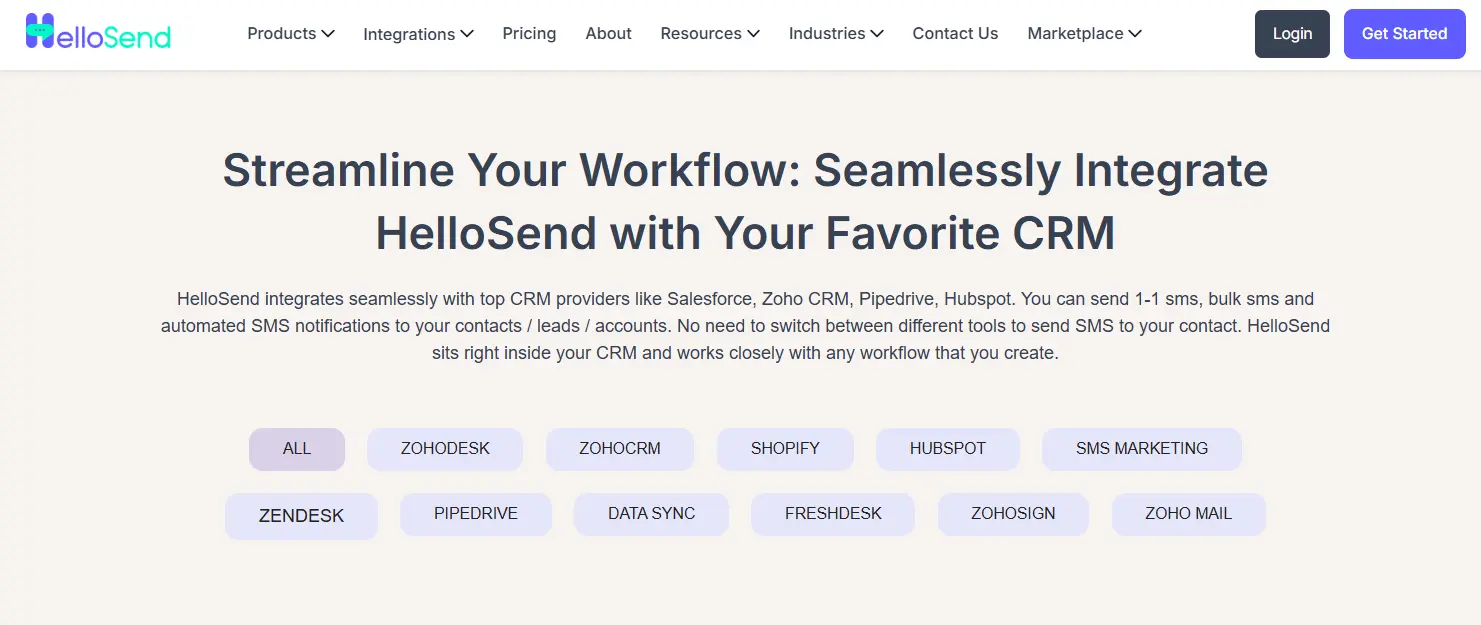
HelloSend offers seamless WhatsApp Business CRM integration, enabling businesses to centralize customer communications and boost their sales and support operations. You can explore various integrations like MS Teams, Hubspot, Zoho, and many more.
By connecting WhatsApp directly to your CRM system, HelloSend enables you to capture and organize leads automatically, track deals in real time, and maintain personalized communication. Check all HelloSend Integrations.
HelloSend Pricing
HelloSend can grow with you. Each pricing plans are designed to help businesses streamline their WhatsApp communication, automate processes, and improve sales and customer support. For more detailed information, visit: HelloSend Pricing Plans.

Best Practices to Maximize Your WhatsApp Business CRM
- Start with Clear Pipeline Stages: Define clear stages to ensure consistency. From initial contact to closing, every stage should be well-defined, so your team knows exactly where each lead stands. A clear pipeline ensures smoother deal progression and faster conversions.
- Define Team Roles and Chat Routing Rules: Assign specific roles and responsibilities to each team member. Set up chat routing rules to ensure the right person handles each conversation based on expertise or availability. This eliminates confusion, improves response times, and keeps the process streamlined.
- Implement 3 Core Automation Flows First: Begin by implementing three key automation flows that can immediately increase efficiency: Welcome messages, Follow-up reminders, Payment confirmations, and Order status updates. These foundational automations reduce manual work and ensure timely communication, keeping leads warm and engaged.
- Monitor Conversion and Response Metrics Weekly: Track key metrics like response time, conversion rate, and deal velocity weekly. Monitoring these numbers helps you identify areas for improvement, ensure quick follow-ups, and spot trends that can optimize your team’s workflow and increase revenue.
- Continuously Optimize Messaging Templates: Regularly review and optimize your messaging templates for clarity, engagement, and relevance. Personalize and update them based on customer feedback and performance data. Refining your templates keeps your communication fresh, efficient, and aligned with customer expectations.
Final Words!
Unmanaged WhatsApp conversations lead to chaos. Sales reps juggle messages in personal inboxes, follow-ups get missed, and leads slip through the cracks. Without a structured WhatsApp business CRM, growth becomes unpredictable, and revenue is often left on the table.
However, with proper WhatsApp business CRM integration, WhatsApp transforms into a scalable, revenue-generating powerhouse. Every conversation is logged and tracked, deals move seamlessly through the pipeline, and WhatsApp automation ensures no lead is left behind. Structured follow-ups, real-time tracking, and insightful performance analytics become the foundation for systematic growth.

FAQs
1. What is a WhatsApp Business CRM, and how is it different from WhatsApp Business?
A WhatsApp Business CRM integrates WhatsApp conversations directly into a CRM system, allowing for structured lead tracking, automation, and performance analytics. Unlike WhatsApp Business, which only supports messaging, a CRM provides visibility, organization, and reporting to manage customer interactions effectively.
2. How does WhatsApp Business CRM integration improve lead conversion rates?
WhatsApp business CRM integration ensures faster response times, automated follow-ups, and seamless lead tracking. This structure helps sales teams engage leads more efficiently, leading to higher conversion rates and fewer lost opportunities.
3. Can automated WhatsApp messaging feel personal and not spammy?
Yes, automated WhatsApp messaging can be personalized using customer data, segmentation, and behavior triggers. This creates relevant and timely communication, making it feel authentic and engaging rather than generic or spammy.
4. Is WhatsApp CRM software suitable for both sales and customer support teams?
Absolutely! A WhatsApp CRM software centralizes conversations, enabling both sales and support teams to access chat histories, collaborate effectively, and deliver a seamless customer experience throughout the lifecycle.
5. How long does it take to implement a WhatsApp Business CRM for a growing team?
Implementation time varies and typically ranges from a few days to a week for basic setups, depending on your team size and workflows. Many WhatsApp CRM solutions like HelloSend are designed for quick onboarding, so your team can start seeing results fast.


.webp)


.webp)
